

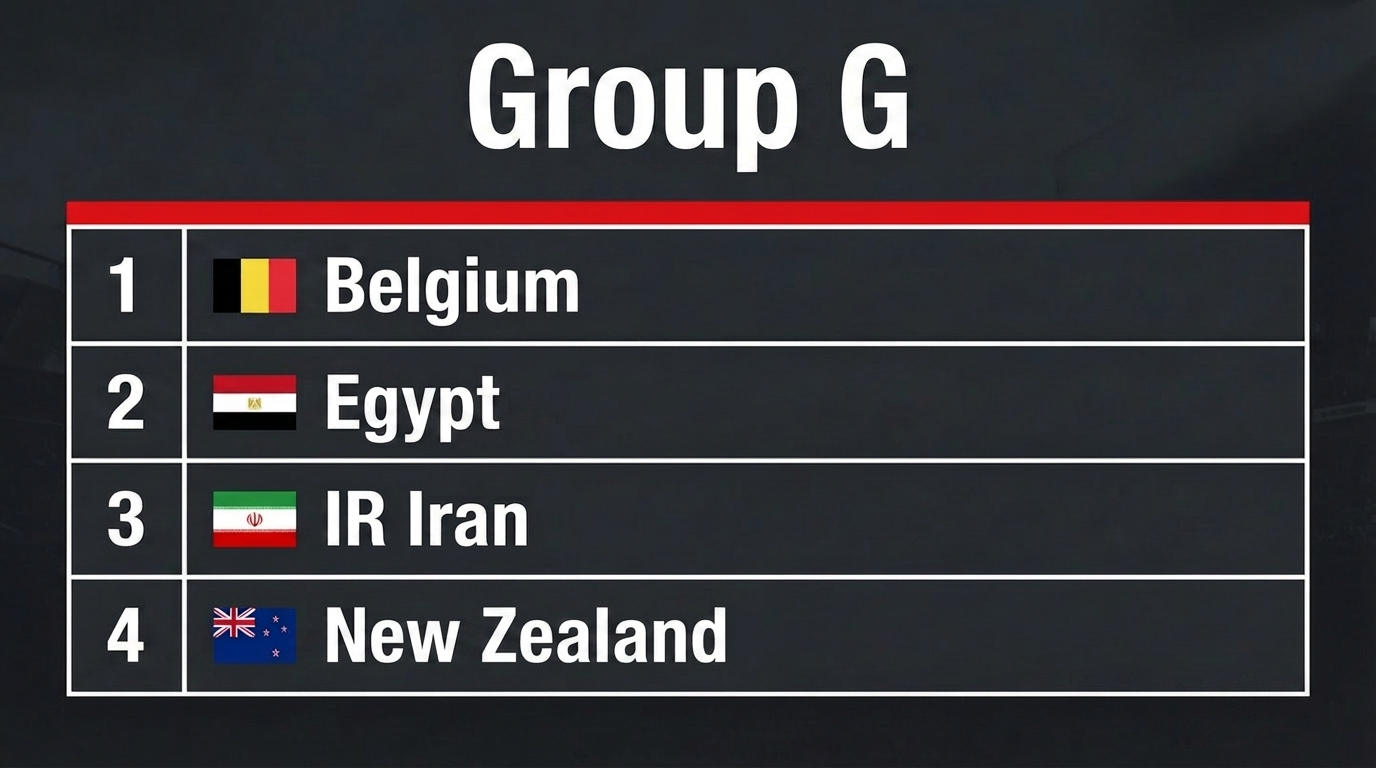
 Group G at the 2026 FIFA World Cup pitches a Belgian squad in generational transition against two of the most star-powered attackers in world football, a defensively organised Asian outfit with significant geopolitical complexity hovering over their participation, and an All Whites side returning to the tournament stage for only the third time in their history. Belgium, Egypt, Iran and New Zealand contest their fixtures across three venues on the US West Coast and in Vancouver – Seattle, Los Angeles and BC Place – in a group that the bookmakers regard as one of the cleaner assignments in the draw for a European heavyweight, but one which contains far more intrigue than the odds alone convey.
Belgium are heavy favourites and with good reason: their squad depth, the enduring quality of Kevin De Bruyne and Thibaut Courtois, and the youthful attacking power of Doku, Openda and De Ketelaere make them a formidable proposition in Group G. But Egypt’s Premier League pairing of Salah and Marmoush is the most exciting two-pronged attack in any of the “second-placed” sides across the twelve groups, and the fixture between them in Seattle could be genuinely explosive. For context across the full tournament, see our World Cup 2026 hub, browse all twelve pools on our World Cup 2026 groups guide, and track the latest market prices on our World Cup 2026 odds page.
Belgium: De Bruyne’s Last Dance and the Next Generation Arrives
 The question that followed Belgium’s “golden generation” for a decade – when would they finally win something? – has now been definitively answered. They didn’t. That generation peaked with a third-place finish at the 2018 World Cup, the best result in the nation’s history, and gradually disbanded. What manager Rudi Garcia – appointed in January 2025 in his first international job after spells at Lille, Roma, Marseille, Lyon, Al-Nassr and Napoli – now oversees is a genuinely compelling hybrid: veterans in their final acts alongside one of the most exciting young attacking generations any Belgian side has possessed.
Kevin De Bruyne (Napoli, 115 caps) is the pivot around which everything turns. Ranked as the greatest Premier League midfielder of all time by FourFourTwo, the 34-year-old remains capable of finding passes others cannot see, dangerous from set pieces, and authoritative in controlling tempo from an advanced midfield position. His fitness heading into June will be the single most important factor in Belgium’s prospects of going deep in the tournament. Alongside him in midfield, Amadou Onana provides athleticism and defensive coverage, while Youri Tielemans adds craft and set-piece quality. Axel Witsel, now 37, offers experience at the back of midfield if required.
The attacking department is where Belgium’s future lives. Jérémy Doku (Manchester City) is one of the most direct, devastating wide players at the entire tournament – his dribbling statistics and pace make him almost unplayable on his best days. Lois Openda (Juventus) is a high-octane pressing striker who led the Bundesliga in goals last season. Charles De Ketelaere (AC Milan) offers the creative intelligence in behind. Vice-captain Romelu Lukaku (Napoli), Belgium’s all-time top scorer by over 60 goals, returned to the March 2026 squad after recovering from a thigh tear and remains the experienced finisher option, even if time and the new generation are closing around him. In goal, Thibaut Courtois (Real Madrid) is one of the world’s elite stoppers and the foundational figure behind a defence that can be exposed on the counter.
Belgium qualified from UEFA Group J unbeaten, capping their campaign with a 7-0 rout of Liechtenstein. They defeated the USA 5-2 in a March 2026 friendly, which while not wholly reliable – friendlies rarely are – reminded the market why this squad commands genuine respect. Garcia has shown tactical flexibility between a 4-3-3 and a 4-2-3-1, and that adaptability will serve him well across three very different group opponents.
Egypt: Salah, Marmoush and the World Cup Return
 Egypt’s return to the World Cup – after missing out entirely in Qatar 2022 – is built almost entirely on the excellence of two Liverpool and Manchester City regulars, and the tactical discipline that manager Hossam Hassan has quietly assembled around them. The Pharaohs qualified from CAF Group A in dominant fashion: eight wins and two draws from ten matches, a goal difference of +18, and no defeats across the entire campaign. Hassan – a remarkable figure who holds Egypt’s all-time scoring record and is now the first person in history to take Egypt to the World Cup as both a player (1990) and a manager – has taken a side accustomed to AFCON contention and prepared it for the very different demands of the global stage.
The key duo is the most Premier League-connected attacking partnership anywhere in Group G. Mohamed Salah, who confirmed in March 2026 that he will leave Liverpool at the end of this season after nine legendary years at Anfield and over 250 goals for the club, arrives at his second World Cup with 67 international goals and in the form of his professional life. He missed the March warm-up matches with a muscle injury picked up against Galatasaray in the Champions League, but is expected to be fully fit for June – and at 33, with a point to prove on the world stage, he will be supremely motivated. Omar Marmoush (Manchester City), one of the Premier League’s breakout performers this season after his move from Eintracht Frankfurt, adds a different dimension: technically sharp, high-energy, relentless in his pressing and clinical in front of goal. The two together form a partnership that could trouble any defence in Group G, and potentially beyond.
The Egyptian squad’s reliance on domestic-based players beyond that attacking duo is a genuine limitation. The spine draws heavily on Al Ahly and Zamalek, clubs of enormous stature within Egypt but operating at a level several tiers below Belgium’s Premier League and Serie A regulars. Mahmoud ‘Trezeguet’ Hassan (Al Ahly) provides experienced wide support and was instrumental in the 2018 World Cup squad. Midfielder Emam Ashour (Al Ahly) and the assured Mohamed Abdelmonem (Nice) in defence are the other notable European-based contributors. Egypt have never won a match at the FIFA World Cup in their three appearances (1934, 1990, 2018) – the pressure on Salah and Marmoush to be the generation that finally delivers is immense.
Iran: Football in the Shadow of Crisis
 Any honest account of Iran’s participation at the 2026 World Cup must acknowledge a context that extends far beyond the footballing. In January 2026, multiple Iranian footballers and athletes were among those killed during the 2026 Iran massacres amid ongoing domestic protests. Former Iran captain Masoud Shojaei publicly criticised FIFA for silence over the deaths of Iranian athletes. Activists called on FIFA to ban the national team from the tournament. Iran’s participation therefore carries political and humanitarian dimensions that dwarf any tactical analysis, and UK audiences – and any responsible bookmaker – should acknowledge this context.
On purely footballing terms, manager Amir Ghalenoei – in his second spell in charge – oversaw an AFC qualifying campaign of considerable efficiency, finishing first in their group with 23 points. Iran are making their fourth consecutive World Cup appearance and, while they have never progressed beyond the group stage, they arrive with a structured, organised side that is difficult to break down. The system is typically a compact 4-2-3-1 built around swift transitions, with the pressing intensity designed to disrupt the rhythm of teams that expect comfortable technical dominance.
The squad’s most prominent individual is captain Mehdi Taremi (Olympiacos), Iran’s third all-time top scorer with 56 international goals, who moved to Greece in search of regular minutes ahead of this tournament and has been in excellent form – 16 goals in 35 appearances this season, including a Champions League goal against Real Madrid. He is Iran’s most dangerous individual and their only truly elite-level European talent. Saeid Ezatolahi and Saman Ghoddos provide midfield experience, while Milad Mohammadi (AEK Athens) contributes from left-back. The absence of Sardar Azmoun through injury has reduced their attacking depth considerably. Much of the squad plays in the Persian Gulf Pro League, which represents a marked drop in competitive intensity compared to their Group G opponents.
New Zealand: The All Whites’ Third World Cup, Built Around One Premier League Star
 New Zealand’s return to the World Cup – their third appearance in the tournament’s history and first since 2010 – is the product of a flawless OFC qualifying campaign: five wins from five, 19 goals scored, one conceded. Manager Darren Bazeley – a former Watford, Wolves and Walsall right-back who moved to New Zealand in 2005 following teammate Danny Hay – has quietly built a squad with genuine structural quality, even if it will face enormous quality gaps against Belgium and Egypt in particular. Bazeley’s appointment was not straightforward: the recruitment process was chaotic, but he has vindicated his selection with a professional, methodical preparation that has brought the All Whites back to football’s biggest stage.
The squad is built almost entirely around one player: Chris Wood (Nottingham Forest). At 33, Wood is New Zealand’s captain, most-capped player and all-time record goalscorer, and his Premier League career has provided him with the level of experience that separates him from every other player in the squad. He scored nine times in OFC qualifying – more than double any teammate – and his physical presence, aerial quality and capacity to hold up play in advanced positions make him the focal point of everything New Zealand do going forward. Wood scored 20 Premier League goals for Nottingham Forest in the 2024-25 season, competing with Salah, Haaland and Isak in the Premier League scoring charts. However, he has struggled with fitness this current season and his sharpness for June will be crucial to the All Whites’ prospects.
Around Wood, there are players of genuine if limited quality. Liberato Cacace (Wrexham) is the most technically polished player in the squad outside Wood – he is a regular in Wrexham’s Championship push this season and brings an attacking left-back presence that creates genuine width. Marko Stamenic and Joe Bell provide midfield solidity, while Sarpreet Singh offers creativity in the half-spaces. Several players are based in the Sky Bet EFL, giving Bazeley a squad with genuine competitive match hardening, if not elite-level opposition experience. New Zealand drew all three group games at the 2010 World Cup, including a famous 1-1 result against Italy, and have never lost fewer than all three in their previous campaign (1982). Their realistic objective is to finally claim that maiden World Cup win.
Group G Fixtures
All six Group G fixtures take place between 15 and 26 June 2026, spread across three venues: Lumen Field in Seattle, SoFi Stadium in Los Angeles, and BC Place in Vancouver. All three venues sit in the Pacific Daylight Time zone (PDT = BST −8). UK fans face notably challenging kick-off times for this group. Coverage will be available across BBC and ITV, with streaming on BBC iPlayer and ITVX – full broadcast allocations confirmed closer to the tournament.
| Date | UK Time | Match | Venue |
| Mon 15 June 2026 | 20:00 BST | Belgium vs Egypt | Lumen Field, Seattle |
| Tue 16 June 2026 | 02:00 BST | Iran vs New Zealand | SoFi Stadium, Los Angeles |
| Sun 21 June 2026 | 23:00 BST | Belgium vs Iran | SoFi Stadium, Los Angeles |
| Mon 22 June 2026 | 05:00 BST | New Zealand vs Egypt | BC Place, Vancouver |
| Sat 27 June 2026 | 04:00 BST | Egypt vs Iran | Lumen Field, Seattle |
| Sat 27 June 2026 | 04:00 BST | New Zealand vs Belgium | BC Place, Vancouver |
The Group G opener – Belgium vs Egypt at Lumen Field in Seattle at 8pm BST – is the prime UK viewing window across the entire group and sets the tone for the second-place race. The Egypt vs Iran fixture is the match that has attracted additional attention due to its designation as Seattle’s “Pride Match” by local organisers, a decision that has created significant controversy given both nations’ domestic laws on LGBTQ+ rights. The final matchday on 27 June sees both games kick off simultaneously at 4am BST, as required by FIFA protocol.
Group G Odds & Predictions
Belgium are the overwhelming favourites across all major UK bookmakers. Belgium to win the group is available at around 8/11 to 4/5 – odds reflecting a roughly 70% implied probability. That pricing is justified: their squad depth, the quality of De Bruyne and Courtois, and the attacking menace of Doku, Openda and the returning Lukaku make them a team that should manage Group G with something to spare. The key risk is the fitness of their veteran core. If De Bruyne is not at full tilt for the Belgium vs Egypt opener, Rudi Garcia’s side will face a far sterner test than the odds suggest.
Egypt to qualify from the group are priced at around 4/6 to 8/11 – a market that effectively reflects the probability of second place. Given that Salah and Marmoush represent as potent an attacking partnership as any “underdog” side at this tournament, and given that Egypt finished their qualifying campaign with 18 wins and two draws from ten matches without conceding, that qualification price looks fair rather than generous. Egypt to win the group at around 4/1 – is the longer-odds play that carries genuine merit if De Bruyne’s fitness is compromised.
Iran to qualify are available at around 5/1 to 6/1 across the main UK bookmakers, and New Zealand to qualify at around 14/1 to 16/1 – the latter reflecting their OFC origins and the quality chasm between them and the group’s top two. However, the expanded format means that even a third-place finish at Group G could potentially be enough to advance if the goal difference holds – a consideration that adds very marginal value to each team’s advancement price.
Our prediction: Belgium top the group; Egypt qualify in second. The Salah vs De Bruyne opening fixture in Seattle on 15 June is not only Group G’s defining match – it is one of the most anticipated individual clashes of the entire tournament group stage. Belgium should manage it, but it will be closer than the odds imply. The standout value bet in Group G is Egypt to qualify at 4/6 – a near-certainty for a side with Salah and Marmoush in harness and a solid defensive record behind them.
Follow all the Group G developments and shifting odds through our World Cup 2026 hub, track how this group compares to the other eleven pools on our World Cup 2026 groups page, and find the best available prices on our World Cup 2026 odds hub.
Group G offers one of the tournament’s genuine Premier League grudge matches – Salah and Marmoush against the Belgian stars of England’s top flight – alongside history-makers in New Zealand and the weight of geopolitical context surrounding Iran. The 8pm BST opener in Seattle on 15 June is mandatory viewing for any serious follower of international football.