

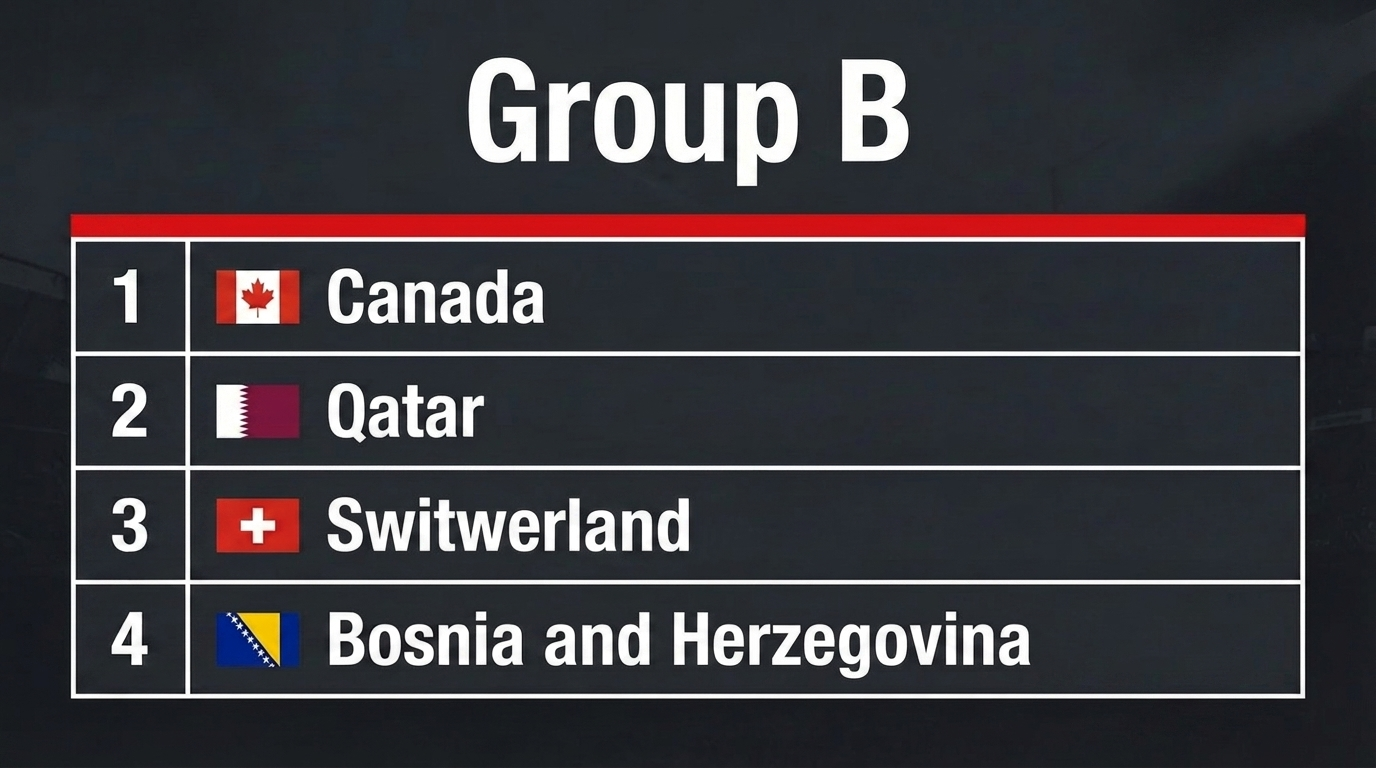
World Cup 2026 Group B was already considered one of the more navigable sections of the draw – then Italy lost on penalties to Bosnia and Herzegovina on 31 March, and the entire calculus shifted. What would have been a legitimate challenge for co-hosts Canada became one of the most favourable group-stage scenarios in the tournament. The Canadians are joined by Switzerland, the tactically refined European stalwarts who breezed through UEFA qualifying without dropping a single game; Qatar, the two-time AFC Asian Cup holders who qualified on merit for the first time in their history after hosting 2022; and Bosnia and Herzegovina, whose dramatic penalty shootout conquest of the Azzurri sent shockwaves across European football.
All three of Canada’s fixtures are played on home soil – two in Vancouver and one in Toronto – giving Jesse Marsch’s side an advantage no other team in the group can match. Switzerland are priced as group favourites at most bookmakers despite that edge, a reflection of their superior FIFA ranking (19th globally) and remarkable recent form. The real fascination in Group B lies in the race for second place and the betting angles that come with it. Bosnia’s upset pedigree, Qatar’s tactical evolution under Julen Lopetegui, and Canada’s injury-interrupted build-up all combine to make this group considerably more interesting than the odds initially suggest.
For a broader overview of every section in the tournament, visit our comprehensive World Cup 2026 groups guide.
Canada – Home Advantage, Historic Opportunity and an Injury Scare
 Canada enter their third-ever World Cup appearance carrying the weight of a nation that has only recently discovered it can compete at football’s summit. Their 2022 campaign in Qatar ended without a single point – yet the seeds of something genuine were visible, most strikingly in Alphonso Davies scoring Canada’s first-ever World Cup goal in a 4-1 defeat to Croatia. Four years on, the squad is stronger, the manager has a clear identity, and playing all three group matches on Canadian soil has given the entire programme a focal point it has never previously enjoyed.
Davies, the Bayern Munich left-back, is the face of Canadian football and arguably the most dangerous wide player the CONCACAF region has produced in a generation. His pace, crossing quality and ability to break lines from deep make him a unique weapon in Jesse Marsch’s pressing system. However, Davies has been battling a hamstring injury that has limited his involvement in recent months, and ensuring he is match-fit for the tournament opener at BMO Field is Canada’s most critical preparation task. When available and sharp, his presence transforms the entire left flank.
Up front, Jonathan David is the primary goal threat. The former Lille man – who scored over 100 goals in Ligue 1 before moving to Juventus – has been finding his feet in Serie A, with his goals-per-game rate dipping from the extraordinary standard he set in France. His output this season gives cause for mild concern, but David remains a player of proven quality in elite European competition, and Canada’s attacking system is built around his runs and finishing ability. Tajon Buchanan of Villarreal provides wide dynamism, while veteran midfielder Stephen Eustáquio of Porto is arguably the most tactically important player in the squad, providing the engine and intelligence that allows the more creative forces around him to function.
Manager Jesse Marsch, the American who previously took Leeds United to Premier League safety in 2022, favours a high-pressing 4-4-2 with intense transitions. That system has conceded goals against stronger opponents – Canada shipped 21 goals in 27 matches under Marsch – but it generates chances and suits the pace available in the squad. A home World Cup in front of packed, red-clad crowds in Toronto and Vancouver could be the catalyst this golden generation needs to finally deliver a knockout-stage appearance. Canada are available around 9/4 to win Group B – a price that warrants serious consideration.
Switzerland – La Nati’s Perfect Qualifying Record Sets the Tone
 If any team in Group B can claim to have arrived at this tournament in outstanding form, it is Switzerland. Murat Yakin’s side became the first European team ever to complete a qualifying campaign with a perfect ten wins from ten, conceding just two goals in the process. That is not merely a statistical quirk – it is a reflection of a tactically disciplined, experienced side that knows precisely how to extract results under pressure. For UK football fans, Switzerland carry a particular resonance this tournament, because the man who makes them tick plays his club football in the Championship: Granit Xhaka of Sunderland.
Xhaka’s story has become one of the genuine feel-good narratives of recent European football. After his controversial Arsenal exit, a season as part of Xabi Alonso’s invincible Bayer Leverkusen side restored his reputation, before a return to English football with newly promoted Sunderland elevated it further. At 33, he captains both club and country with authority, described by Swiss media as “tactically intelligent” and “the heartbeat” of Yakin’s system. His long-range passing range, set-piece delivery and composure under pressure have made him one of the most respected midfielders on the international stage – and he is the first name on every Switzerland teamsheet. In the March warm-up against Germany, Switzerland were beaten 4-3, but Xhaka’s half-time withdrawal was planned rather than a sign of physical concern.
The supporting cast is impressive across every line. Manuel Akanji of Inter Milan provides elite-level defensive composure at centre-back. Gregor Kobel of Borussia Dortmund is one of the finest goalkeepers in the Bundesliga. Dan Ndoye of Nottingham Forest adds Premier League pace and directness in wide areas. Up front, Breel Embolo of Stade Rennais scored four goals in six qualifying appearances, giving Switzerland a physical goal threat who can operate as both a poacher and a link player. Zeki Amdouni of Burnley and Noah Okafor of Leeds United complete a forward line with genuine Championship pedigree – a detail that should not be lost on UK audiences.
Yakin’s preferred shape – a flexible 3-4-3 that can shift to 4-3-3 – suits the versatility within his squad and makes Switzerland genuinely difficult to break down. They made the quarter-finals of Euro 2024, defeating Italy en route before losing to England on penalties. That result stings but also signals a side capable of the very best on their best days. Switzerland are available around 4/6 to win Group B – a short price, but perhaps a fair one given their near-flawless recent record.
Bosnia and Herzegovina – Penalty Shootout Heroes with a Fragile Talisman
 The story of Bosnia and Herzegovina’s qualification for World Cup 2026 deserves to be told in full, because it provides essential context for any betting assessment of their group-stage prospects. On 31 March 2026, in front of a heaving Stadion Bilino Polje in Zenica, Sergej Barbarez’s side defeated four-time world champions Italy on penalties – a result that confirmed Bosnia’s place at their second-ever World Cup and consigned the Azzurri to a third consecutive failure to qualify. The scenes of celebration across Bosnia-Herzegovina were extraordinary, and the sense of national identity and purpose this squad carries into the tournament is palpable.
The central figure, as he has been for nearly two decades, is Edin Džeko. The former Manchester City, Roma and Juventus striker is 40 years old, playing in the 2. Bundesliga with Schalke, and still leading the line for his country. He holds both Bosnia’s appearance record (146 caps) and all-time scoring record (72 goals), and his 40-year career at the highest level – including becoming the oldest goalscorer in 2. Bundesliga history earlier this season – represents one of the most remarkable stories in modern European football. The complication: Džeko injured his shoulder in the dying minutes against Italy and was unable to take part in the shootout. Manager Barbarez was publicly anxious afterwards, stating there was “not much time” for recovery before June. His fitness is the single most important variable in Bosnia’s tournament prospects.
Without Džeko at his best, manager Barbarez still has quality to call upon. Ermedin Demirovic of Stuttgart is a technically gifted forward who performs the pressing and link-up work that gives Džeko room to operate in the box. Midfielders Benjamin Tahirović and Armin Gigović provide the engine-room dynamism on which Barbarez’s high-energy transitions depend. Goalkeeper Nikola Vasilj of FC St. Pauli has Premier League-adjacent experience and is a reliable presence between the posts.
Bosnia’s tactical blueprint is direct and physically demanding – Barbarez prioritises quick transitions and vertical passing over sustained possession. That style can trouble technically superior opponents on a given day but becomes predictable against well-organised defences. Their qualification run, which saw them edge past Wales on penalties before repeating the feat against Italy, tells us they are supremely resilient in knockout football but does not guarantee Group B success. Bosnia are priced around 7/2 to win Group B, with their qualification price sitting around 11/10 – the latter represents reasonable value if Džeko recovers in time.
Qatar – From Hosts to Contenders Under a Familiar Premier League Face
 Qatar’s 2022 World Cup experience as hosts was, by any measure, difficult. They became the first home nation ever to be eliminated at the group stage, finishing bottom of their group without a win, having scored one goal and conceded seven. The question heading into 2026 is whether Julen Lopetegui – appointed in May 2025 – has transformed the squad sufficiently to avoid a repeat. The honest answer from the market is: not quite. But dismiss Qatar at your peril, because this is a meaningfully improved side, and Lopetegui is a manager with a proven pedigree at the highest level.
Lopetegui will be familiar to UK audiences from two turbulent Premier League tenures – a truncated stint at Wolves in 2023 and an even shorter spell at West Ham that ended in the sack. Before those experiences, however, his CV included leading Spain to the 2018 World Cup, winning the UEFA Europa League with Sevilla and managing Real Madrid and Porto. He arrived in Qatar with a clear brief: instil tactical identity, build pressing structure and unlock the country’s most gifted players. His 4-2-3-1 or 4-3-3 system places a premium on midfield control and quick delivery into the forwards.
The standout name is Akram Afif, the technically gifted attacking midfielder and two-time AFC Player of the Year. Afif’s close control, vision and directness make him Qatar’s most dangerous creator and the player most likely to produce a moment of quality against the group’s stronger sides. Almoez Ali is the all-time leading scorer with 55-plus goals in 118 appearances and has the movement and finishing instincts of a clinical poacher – though he has never scored at a World Cup, a fact that is becoming difficult to ignore. Captain Hassan Al-Haydos, who came out of international retirement for this campaign having scored 41 goals in 184 appearances, gives the squad experience and character in crucial moments.
Almost the entirety of Qatar’s squad play domestically in the Qatar Stars League, a factor that has raised questions about the level of preparation for facing European and North American opposition. Their pre-tournament warm-up friendlies – including a scheduled fixture against Republic of Ireland – should provide useful data, but the market’s current assessment feels broadly right. Qatar are priced around 20/1 to win Group B. Their most realistic route to progression is via the best third-place route, a longer shot still. The most actionable market for Qatar is both teams to score in their fixture against Bosnia – two sides who need to attack.
World Cup 2026 Group B Fixtures
All three of Canada’s Group B matches are played on home soil, while Switzerland and Bosnia travel to California and Seattle respectively for their non-Canada fixtures. All times are UK BST. Matches are expected to be broadcast across BBC and ITV in the UK, with streaming available via BBC iPlayer and ITVX.
| Date | UK Time (BST) | Match | Venue |
| Fri 12 Jun | 20:00 | Canada vs Bosnia & Herzegovina | BMO Field, Toronto |
| Sat 13 Jun | 20:00 | Qatar vs Switzerland | Levi’s Stadium, Santa Clara |
| Thu 18 Jun | 20:00 | Switzerland vs Bosnia & Herzegovina | SoFi Stadium, Inglewood |
| Thu 18 Jun | 23:00 | Canada vs Qatar | BC Place, Vancouver |
| Wed 24 Jun | 20:00 | Switzerland vs Canada | BC Place, Vancouver |
| Wed 24 Jun | 20:00 | Bosnia & Herzegovina vs Qatar | Lumen Field, Seattle |
The simultaneous final-round fixtures on 24 June are the ones to watch from a betting perspective. Switzerland vs Canada in Vancouver is the headline fixture that will likely determine who tops the group, while Bosnia vs Qatar in Seattle takes on enormous significance for both sides fighting to avoid an early exit. Expect both late-round matches to feature heavily in same-game accumulator markets as the tournament approaches.
Group B Odds & Predictions: Switzerland to Win, Canada’s Home Crowd to Deliver
The World Cup 2026 odds for Group B are clear in their hierarchy: Switzerland are favourites at approximately 4/6, with Canada next at around 9/4, Bosnia at 7/2 and Qatar at a distant 20/1. The market is almost certainly right to make Switzerland favourites – their qualifying record is exceptional, their captain is in the form of his career, and the spine of their team features players from Inter Milan, Borussia Dortmund and Nottingham Forest. They are organised, experienced and tactically adaptable.
The most interesting value, however, lies elsewhere. Canada to qualify from Group B is available around 4/7 at most major bookmakers – a price that looks reasonable given they play all three fixtures at home and avoid the need to travel across the continent. Home advantage at a 30,000-seat BMO Field in Toronto and a raucous BC Place in Vancouver is a genuine factor, not a talking point. If Davies is fit, the opening fixture against Bosnia is eminently winnable, and a comfortable victory against Qatar in their second match would leave the group essentially settled before the Switzerland showdown.
The bet that stands out most clearly from a pure value perspective is Switzerland to win Group B at 4/6. Their 10-from-10 qualifying run is the most compelling piece of recent evidence available, and while Canada’s home advantage is real, Yakin’s side have shown they can deliver results in hostile environments. Switzerland beat both Mexico and the United States in friendlies last year by an aggregate score of 8-2, which underlines just how clinical they can be against North American opposition.
Our prediction: Switzerland win Group B, Canada qualify in second. Bosnia’s drama-laden journey ends here, though Džeko and his teammates will not go without causing at least one significant scare. Qatar’s campaign mirrors 2022 – organised, occasionally resilient, but ultimately outmatched at this level.
For team-by-team breakdowns across all 12 groups, kit details and full knockout bracket analysis, head to our World Cup 2026 hub.