

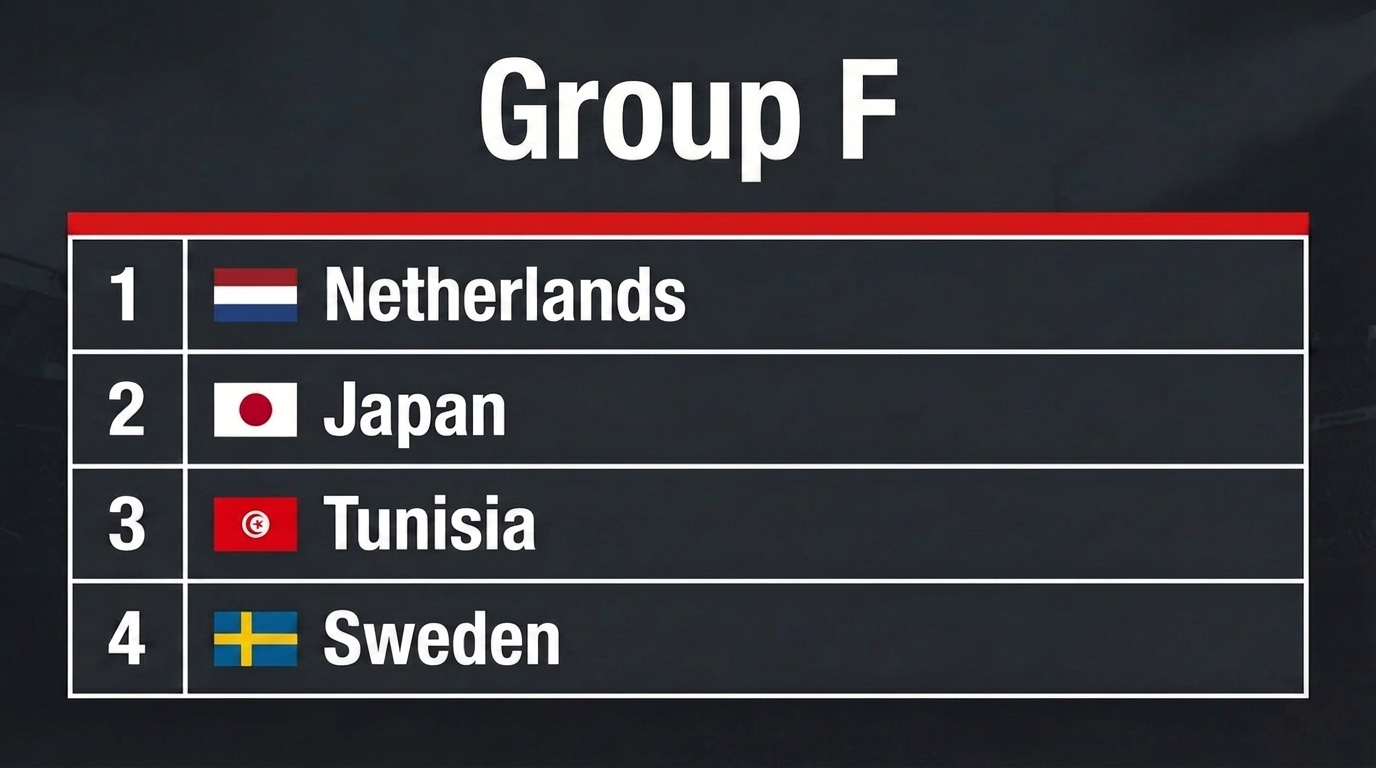
 Group F at the 2026 FIFA World Cup assembles four nations with very different stories to tell, yet a surprisingly level spread of quality that makes this one of the more genuinely open pools at the tournament. Netherlands, three-time World Cup finalists and perpetually one of Europe’s most dangerous sides, carry the weight of unfinished business into a group that also features a Japan side that beat Spain and Germany en route to the round of 16 in 2022, a Sweden team powered by one of the most fearsome strike partnerships in world football, and Tunisia, making their third consecutive World Cup appearance and their seventh overall. The Oranje are bookmakers’ favourites, but this is far from a group where the top two places are settled before a ball is kicked.
With fixtures spread across Arlington, Monterrey, Houston and Kansas City, the group lacks a truly late-night Central American time zone advantage for any individual team. The Japan vs Netherlands opener in Dallas is already being billed as one of the tournament’s standout group-stage clashes, and Sweden’s extraordinary qualification story – winning zero of their ten European qualifying matches before squeezing through the play-offs on a Gyökeres last-gasp winner – adds genuine intrigue. For context on the full tournament picture, visit our World Cup 2026 hub, see how Group F compares across all pools on our World Cup 2026 groups page, and find the latest market prices on our dedicated World Cup 2026 odds page.
Netherlands: Koeman’s Oranje and the Weight of Three Finals
 Three World Cup final appearances and no victories: the Netherlands carry a unique burden into every major tournament, and 2026 is no different. Under Ronald Koeman – in his second stint as national manager after guiding Oranje to the 2022 quarter-finals – they arrive in North America as one of the more credible European contenders, ranked seventh in the world and boasting one of the most Premier League-heavy squads at the tournament.
The defensive foundation is built around Virgil van Dijk (Liverpool), still ranked by FourFourTwo as the world’s finest centre-back and the authoritative presence that sets the tempo for everything Koeman does. At 34, questions about longevity persist at club level, but in an international context – where the rhythm is different and van Dijk has always elevated himself – he remains genuinely world-class. Alongside him, Micky van de Ven (Tottenham Hotspur) brings pace and composure from the left, while Jeremie Frimpong (Bayer Leverkusen) and the recovering Jurrien Timber (Arsenal) add quality across the back four. The full squad is riddled with Premier League and top European league regulars: Nathan Aké (Manchester City), Denzel Dumfries (Inter Milan), Mats Wieffer (Brighton & Hove Albion) and Jan Paul van Hecke (Brighton) all feature.
In midfield, Ryan Gravenberch (Liverpool) and Tijjani Reijnders (Manchester City, formerly AC Milan) provide the engine, while Frenkie de Jong (Barcelona) – when fit – remains one of the most elegant ball-progressors at the tournament. Attacking, the picture is compelling if not quite complete: Cody Gakpo (Liverpool) is the focal point in the final third, electric on his day and capable of manufacturing goals from almost nothing. Xavi Simons (RB Leipzig) is the creative catalyst, while Memphis Depay (Corinthians) – the Netherlands’ all-time leading scorer with 55 international goals – remains the experienced finisher option. Koeman’s 4-3-3 system demands width and movement, and in Frimpong and Gakpo he has players who can provide both.
The Netherlands went through UEFA qualifying unbeaten in eight games, held back only by two draws against Poland. Their depth is substantial. The genuine concern – and it has been consistent through multiple cycles – is whether they can sustain their intensity across a tournament’s full duration, and whether Koeman can extract the best from a group of players who sometimes struggle to replicate their club form at international level.
Japan: Samurai Blue’s Giant-Killer Reputation Demands Respect
 If any team in Group F deserves to make bookmakers nervous, it is Japan. The Samurai Blue arrive at this tournament having beaten Germany twice, Spain once and Brazil once since Qatar 2022. In their most recent pre-tournament friendlies in March 2026, they recorded back-to-back victories over Scotland and England – with the 1-0 win at Wembley marking the first time an Asian side had ever beaten England on home soil. Manager Hajime Moriyasu, who guided them to the round of 16 in 2022 before losing on penalties to Croatia, has built a cohesive, tactically intelligent side that is at its most dangerous precisely when opponents underestimate them.
The squad is laden with European-based quality. Kaoru Mitoma (Brighton & Hove Albion) is one of the most exciting wide players at the tournament – his directness, close control and capacity to create something out of nothing in tight spaces make him a Premier League audience favourite who will draw considerable UK attention. Daichi Kamada (Crystal Palace) brings craft and goal threat from midfield, while Ao Tanaka (Leeds United) provides the engine in the middle of the park. Captain Wataru Endō (Liverpool), the Premier League winner, anchors the defensive midfield with the composure of a seasoned veteran. Takefusa Kubo (Real Sociedad) is the creative force from the right, capable of individual moments that unpick any defence.
Moriyasu typically operates with a 3-4-2-1 formation, packing the middle of the pitch and using wing-backs to stretch play wide while his attacking midfielders operate in the pockets between lines. Against a Netherlands side that can be exposed on the counter when pressing high, this system could be dangerous. The concern for Japan heading into the summer is the injury list: Takumi Minamino has been ruled out with a cruciate ligament injury, and a wave of fitness issues has forced Moriyasu to consider his squad structure carefully. However, the quality that remains – particularly Mitoma, Kubo and the Premier League contingent – is more than enough to trouble any side in Group F.
Japan have reached the round of 16 at each of their last two World Cups. Moriyasu has stated openly that the target in 2026 is to go beyond that stage. With this squad, against these opponents, it is not an unrealistic ambition.
Sweden: Gyökeres, Isak, Potter and the Most Dramatic Qualification in the Draw
 Sweden’s path to the 2026 World Cup finals is one of the most extraordinary stories in the history of UEFA qualifying. They won zero of their ten European qualifying matches, finished bottom of their group, and were reduced to hoping their Nations League Group C1 title would keep their play-off hopes alive – which it did. Manager Jon Dahl Tomasson was sacked in October after a toxic implosion that ended with the “Danish bastard” banner being unfurled in Stockholm, and former Chelsea and West Ham boss Graham Potter was parachuted in on a short-term deal. In his first two matches he failed to win. And yet, on 31 March 2026, a Viktor Gyökeres goal in the 88th minute against Poland sent Sweden to the World Cup in one of the most dramatic play-off finals in living memory.
The contradiction at the heart of Sweden’s story is that they possess, on paper, one of the most lethal strike partnerships at the entire 2026 tournament. Alexander Isak (Liverpool) is one of the finest centre-forwards in the Premier League – technically immaculate, intelligent in his movement, and capable of scoring goals of breathtaking quality. Viktor Gyökeres (Arsenal) has established himself as one of the most feared strikers in European football, with a scoring record that would rank him among the elite at any club on the continent. Together, the pair are worth approximately £235 million at current transfer valuations. The problem – which plagued Tomasson throughout his tenure and which Potter is still resolving – is harnessing both in the same system. Potter’s preferred 3-4-2-1 gives Gyökeres a central focal role with Isak floating around him, and it showed promise in the play-offs.
Beyond the strikers, Sweden have genuine quality in other areas. Anthony Elanga (Newcastle United) is a dynamic, pacey winger who scored in the play-off final against Poland with a bent left-footed curler into the top corner. Victor Lindelöf (Manchester United) captains from centre-back, and Lucas Bergvall (Tottenham Hotspur) is one of the more exciting young midfielders at the tournament. It is worth noting that Isak was absent from the play-off campaign through injury and is expected to be fit for the summer; if both Isak and Gyökeres arrive in North America sharp, Sweden’s attacking ceiling rises considerably.
The caveat is their recent form. Sweden conceded 12 goals in six qualifying matches, scored four, and went winless. Potter has had only three games to reverse that trend. A Gyökeres hat-trick against Ukraine suggested the system can work – but the group stage will be a stern examination of whether he has resolved the collective defensive fragility.
Tunisia: The Eagles of Carthage, Quietly Formidable
 Tunisia tend not to attract the billing they perhaps deserve. They qualified for this World Cup with one of the cleanest records in African football – winning nine of their ten CAF qualifying matches and conceding no goals at all during the qualifying campaign, becoming the first team in history to qualify for a World Cup without shipping a single goal in their qualifying group. That defensive record is not a coincidence; it is a marker of tactical organisation and collective discipline that manager Sami Trabelsi has instilled since taking over for a second spell in February 2025.
Trabelsi, who captained Tunisia at the 1998 World Cup in France, has shaped a compact, hard-working side that may lack the individual star power of their Group F opponents but compensates with cohesion and resilience. In Qatar 2022, despite finishing bottom of their group, Tunisia beat eventual runners-up France 1-0 in their final match – a result that illustrated precisely what this team is capable of when organised and motivated. In November 2025, they held Brazil to a 1-1 draw in Lille. Tunisia do not simply go through the motions against elite opposition.
The squad’s most prominent Premier League representative is Hannibal Mejbri (Burnley), the technically gifted central midfielder who adds creative quality and intensity to the engine room. Ellyes Skhiri (Eintracht Frankfurt) brings experience and intelligence as the defensive midfielder, with 33-year-old captain Ferjani Sassi providing leadership alongside him. In defence, Montassar Talbi (Lorient) and Dylan Bronn (FC Servette) form a experienced back line. Wide areas are covered by Yan Valery – a familiar name to Southampton supporters from his Premier League appearances – and Nice’s Ali Abdi. Youssef Msakni, the third all-time leading scorer for Tunisia, adds experience in attack, though questions about his ability to reproduce such form at tournament level persist.
Tunisia’s goal at this World Cup is to improve on their quarter-final finish at the 1994 and 2022 editions. Their record of four points in Qatar remains their modern benchmark. In a group containing three European sides, they are clear outsiders – but history suggests dismissing the Eagles of Carthage entirely is a mistake.
Group F Fixtures
All six Group F fixtures take place between 14 and 25 June 2026. The group is spread across four venues: Arlington (Dallas), Monterrey in Mexico, Houston and Kansas City. All are in the Central Daylight Time zone (CDT = BST −6), meaning UK fans face some notably late or early starts. BBC and ITV – with streaming via BBC iPlayer and ITVX – are set to carry matches, with final broadcast allocations announced closer to the tournament.
| Date | UK Time | Match | Venue |
| Sun 14 June 2026 | 21:00 BST | Netherlands vs Japan | AT&T Stadium, Arlington (Dallas) |
| Mon 15 June 2026 | 03:00 BST | Sweden vs Tunisia | Estadio BBVA, Monterrey |
| Sat 20 June 2026 | 18:00 BST | Netherlands vs Sweden | NRG Stadium, Houston |
| Sun 21 June 2026 | 05:00 BST | Tunisia vs Japan | Estadio BBVA, Monterrey |
| Thu 25 June 2026 | 00:00 BST (midnight) | Japan vs Sweden | AT&T Stadium, Arlington (Dallas) |
| Thu 25 June 2026 | 00:00 BST (midnight) | Tunisia vs Netherlands | Arrowhead Stadium, Kansas City |
The opening Netherlands vs Japan clash at AT&T Stadium in Dallas at 9pm BST is the pick of the group for UK viewers – a prime-time fixture between two sides who have history, with Japan’s 2022 wins over Germany and Spain fresh in the memory. The final matchday games on 25 June kick off simultaneously at midnight BST, as required by FIFA protocol to prevent tactical collusion.
Group F Odds & Predictions
The Group F winner market is one of the most genuinely competitive in the draw, a fact the bookmakers reflect in their pricing. Netherlands are available at around 4/6 to 8/11 to win the group across bet365, Paddy Power and William Hill – tight enough to suggest the market respects Japan’s potential to disrupt. The Oranje’s unbeaten qualifying campaign and the depth of their Premier League-stocked squad make them worthy favourites, but a team ranked seventh in the world facing the side that beat them in this tournament’s immediate predecessor should inspire caution in anyone laying the Dutch at short odds.
Japan are available at around 3/1 to 7/2 to win the group. Given their record of beating Germany twice, Spain, Brazil and England since 2022, this price is arguably the standout value bet in Group F. Moriyasu’s 3-4-2-1 system is perfectly calibrated to exploit the space behind advancing full-backs, and the Netherlands’ attacking approach means those spaces will exist. Japan’s Premier League contingent – Endō, Mitoma, Kamada, Tanaka – are all familiar with the physical demands of the game at European level, and the opener in Dallas is a potential banana skin for Koeman’s side.
Sweden’s qualification odds sit at around evens to 5/4 – reasonable given their attacking firepower but perhaps generous given the defensive frailties exposed in qualifying. The key question for Potter’s side is whether a sharpened, fit Isak alongside Gyökeres can be as devastating as the pair were in Nations League competition under Tomasson in 2024. If yes, Sweden are a genuine threat to qualify; if Isak’s fitness remains uncertain into June, the task becomes considerably harder. Tunisia to qualify are longer at around 5/2 to 3/1 – a longer shot, but in a group this open, their defensive discipline and experience of the tournament stage are not negligible assets.
Our prediction: Netherlands and Japan advance, with the group winner decided by the Dallas head-to-head on 14 June. Sweden’s attacking potential is undermined by their collective defensive frailty, and Tunisia – disciplined and dangerous against elite opposition – will likely fall agonisingly short. For betting, the outstanding play in Group F is Japan to qualify from the group at around 4/7, and for those with higher risk appetite, Japan to win the group at 7/2 represents genuine value rooted in recent results and proven tactical credentials.
Keep up with all the latest Group F news, injury updates and shifting odds on our World Cup 2026 hub, compare the best prices available across all Group F and tournament markets on our World Cup 2026 odds page, and explore how Group F fits into the wider bracket picture through our guide to all World Cup 2026 groups.
Group F is exactly what the expanded format was designed to produce: four teams who each have legitimate routes to the knockout rounds, a headline opening fixture that could genuinely go either way, and a pair of strikers in Isak and Gyökeres who, on current form, would trouble any defence in the world. Bookmark this page for ongoing updates through May and into June.