

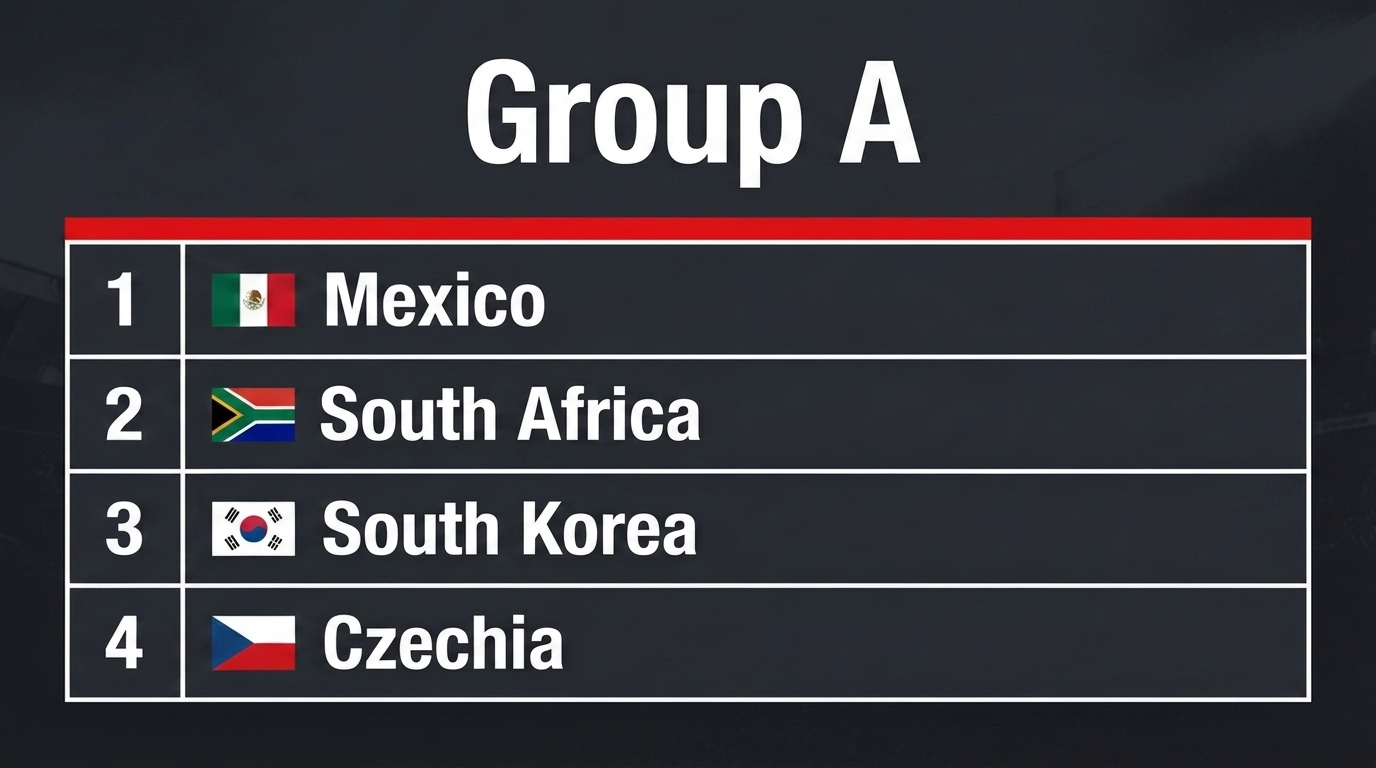
 World Cup 2026 Group A is where the tournament begins – and it delivers genuine drama from the first whistle. Co-hosts Mexico open the entire competition against South Africa on 11 June at the legendary Estadio Azteca, a fixture that carries 16 years of symmetry: these two nations played out a 1-1 draw in the very same slot when South Africa hosted the 2010 World Cup. Completing the group are South Korea and Czech Republic, making this a four-way contest that defies easy prediction.
Mexico carry co-host advantage and altitude. South Korea bring 12 World Cup appearances, an iconic 2002 semi-final in their history and the irrepressible Son Heung-min. Czech Republic are back at the World Cup for the first time since 2006 after surviving a nerve-shredding penalty shootout against Denmark in the European play-offs – a campaign that required Vladimír Darida to come out of international retirement. South Africa, meanwhile, qualify for just their second World Cup since hosting the tournament, driven by goalkeeper Ronwen Williams and Belgian manager Hugo Broos’ pragmatic defensive system.
The expanded 48-team format means the top two sides advance automatically, while the best third-placed team will also progress. Realistically, Mexico and one of South Korea or Czech Republic are expected to take those two automatic berths – but in tournament football, bookmakers and analysts alike have been caught out before. For those betting on the World Cup 2026 groups, this is the group that offers the most compelling narrative in the entire draw.
Mexico – The Hosts Under Pressure
 Mexico arrive at World Cup 2026 carrying the heaviest expectations since 1986, the last time they hosted the tournament. Manager Javier Aguirre, in his third stint in charge of El Tri, guided the side to both the CONCACAF Nations League and Gold Cup titles in 2025 – but the build-up to the tournament itself has been plagued by injury. This is not a squad operating at full capacity, and the betting market needs to account for that.
The most damaging blow has been to the midfield. Marcel Ruiz, arguably the most influential creative player in Aguirre’s 4-3-3 system, tore his ACL in a CONCACAF Champions Cup match and will miss the entire tournament. Edson Álvarez, the captain and first-choice holding midfielder who now plays for Fenerbahçe, underwent ankle surgery and faces a race to be fit for the group stage. The teenage sensation Gilberto Mora – who at 16 became Mexico’s youngest-ever senior international and electrified the Gold Cup – has been recovering from a serious groin issue, though he is expected to return before the tournament. Goalkeeper Luis Ángel Malagón ruptured his Achilles tendon in March, potentially opening the door for the legendary Guillermo Ochoa to make a record-breaking sixth World Cup appearance.
Up front, Raúl Jiménez of Fulham remains the focal point and arguably the most recognisable Mexican name to a Premier League audience. His physical presence and aerial threat give Mexico a reliable reference point, and he is approaching peak fitness at just the right moment. Santiago Giménez of AC Milan is another crucial attacking option, having returned from a lengthy ankle injury of his own. If both are available and sharp, Mexico’s forward line suddenly looks considerably more threatening.
The Azteca’s altitude of 2,240 metres above sea level is a genuine competitive advantage – visiting teams unaccustomed to playing at height will suffer in the final fifteen minutes of each half. Mexico have historically performed far better on home soil than abroad. The only times they have reached the quarter-finals of a World Cup were in 1970 and 1986 – both as hosts. El Tri are available around 4/5 to win Group A, which feels a touch short given their injury concerns heading into the group stage.
South Korea – Asian Pedigree and a Star in Transition
 South Korea arrive at their 12th World Cup – the most appearances of any Asian nation – with a fascinating subplot. Son Heung-min, the former Tottenham Hotspur captain who spent a decade delighting Premier League audiences, now plays his club football for Los Angeles FC in Major League Soccer. At 33, he remains the team’s talisman and captain, but the question of whether MLS minutes keep him sharp enough for a major tournament is one the South Korean faithful have been debating since his departure from Spurs. For UK supporters with a soft spot for the Premier League, Son’s story remains one of the most compelling threads running through Group A.
Manager Hong Myung-bo, who captained the side during their remarkable 2002 semi-final run on home soil, is in his second stint in charge. He has built a tactically fluid side capable of operating in a high press or sitting in a compact mid-block depending on the opponent – useful versatility at a tournament where fixture-by-fixture adaptability is essential.
The supporting cast includes Lee Kang-in of Paris Saint-Germain, a technically gifted attacking midfielder who has matured significantly under Luis Enrique in Ligue 1, and Kim Min-jae, the Bayern Munich centre-back who has become one of Europe’s elite defenders. Their defensive solidity through Kim and a well-organised backline gives South Korea a platform to be dangerous in transition – exactly the style that troubled Portugal and upset expectations at the 2022 Qatar World Cup, where they reached the round of 16 before a 4-1 defeat to Brazil.
The concern is recent form. South Korea lost to Ivory Coast 4-0 and Austria 1-0 in World Cup warm-up fixtures, results that exposed vulnerabilities against organised pressing sides. Czech Republic’s high-energy approach could replicate those conditions. Nevertheless, South Korea’s wide pace and quick transitions represent a genuine threat against any Group A opponent, and bookmakers price them around 10/3 to win the group – a price that likely underestimates their ceiling.
Czech Republic – Twenty Years in the Wilderness, Back with Intent
 The Czech Republic’s return to the World Cup stage – their first appearance since 2006 – carries a particular resonance for UK football followers. The qualification journey alone was extraordinary: needing a penalty shootout victory over Denmark in the European play-offs, having previously defeated the Republic of Ireland to get there. The Czechs did not stroll to this tournament; they clawed their way through.
Manager Miroslav Koubek, 74, was appointed after Ivan Hašek’s tenure ended following a catastrophic 2-1 defeat to the Faroe Islands. A Prague-born former goalkeeper who spent his entire managerial career in Czech club football, Koubek won the league title twice with Viktoria Plzeň and brought calm and structure to a squad that was fractious and underperforming. His philosophy is built on organisation, defensive discipline and exploiting set-pieces – a style that ages well in knockout football but can be exposed by teams with technical quality in midfield.
The danger man is Patrik Schick, the Bayer Leverkusen striker who scored 24 goals in 50 international appearances and is best remembered in English football for that stunning halfway-line volley against Scotland at Euro 2020. His ability to score from seemingly nothing makes him a constant threat, and at 30 he enters this tournament at the peak of his physical and technical powers. Captain Tomáš Souček of West Ham United brings Premier League physicality and aerial dominance from midfield, while the creative burden falls on Pavel Šulc of Lyon, a dynamic wide midfielder who can unlock defences in tight spaces. Ladislav Krejčí of Wolverhampton Wanderers anchors the defence and carries Premier League pedigree.
Veteran Vladimír Darida, 35, came out of retirement specifically to help the team qualify. Whether he features at the tournament itself remains uncertain, but his inclusion underlines the character within this squad. Czech Republic are priced around 9/4 to win Group A – a realistic assessment of a team that could finish second, but will need all of Schick’s best form to trouble Mexico in what is likely to be the decisive final group fixture.
South Africa – Bafana Bafana’s Moment of Redemption
 The last time South Africa played in a World Cup, they became the first and only host nation to be eliminated at the group stage. Sixteen years on, Hugo Broos has rebuilt Bafana Bafana into a genuinely competitive side – one that qualified by edging Nigeria at the top of their African qualifying group and claimed a bronze medal at the 2023 Africa Cup of Nations. This is not a side merely participating. They believe they can cause damage.
The tactical blueprint Broos has assembled over five years prioritises defensive organisation and rapid counter-attacks through wide areas. South Africa defend in compact blocks, absorb pressure patiently and then transition at pace – a style that suits one-off fixtures beautifully and has troubled better-fancied African opponents throughout qualifying. The system’s primary limitation is converting performances into goals against top-tier opposition.
Ronwen Williams, the Mamelodi Sundowns goalkeeper and team captain, is arguably the most important player in the squad. His shootout heroics at the 2023 AFCON – saving four penalties against Cape Verde in the quarter-finals – confirmed what South African football had known for years: he is among the finest goalkeepers on the continent. Percy Tau, the experienced forward who has played for Brighton, Club Brugge and Al Ahly, provides attacking quality and European nous, though his consistency at international level has fluctuated throughout his career. Teboho Mokoena is the midfield engine, a combative ball-winner who has racked up over 50 international caps and provides the defensive platform Broos demands.
The altitude games in Mexico City and Monterrey represent real logistical challenges – Broos has emphasised acclimatisation in the camp preparations. South Africa’s best hope of progression lies in the Monterrey final fixture against South Korea, a match where both sides may be playing for their tournament lives. Bafana Bafana are priced around 12/1 to win the group and roughly 11/8 to qualify from third – the latter is the market the value-conscious punter should be examining most carefully.
World Cup 2026 Group A Fixtures
All six Group A fixtures are listed below with UK kick-off times. Five of the six matches take place in Mexico, with the sole exception being Czechia vs South Africa in Atlanta on 18 June. Games are expected to be broadcast across BBC and ITV in the UK, with full coverage available via BBC iPlayer and ITVX.
| Date | UK Time | Match | Venue |
| Thu 11 Jun | 20:00 | Mexico vs South Africa | Estadio Azteca, Mexico City |
| Thu 11 Jun | 03:00 (Fri) | South Korea vs Czech Republic | Estadio Akron, Guadalajara |
| Thu 18 Jun | 17:00 | Czech Republic vs South Africa | Mercedes-Benz Stadium, Atlanta |
| Thu 18 Jun | 02:00 (Fri) | Mexico vs South Korea | Estadio Akron, Guadalajara |
| Wed 24 Jun | 02:00 (Thu) | Mexico vs Czech Republic | Estadio Azteca, Mexico City |
| Wed 24 Jun | 02:00 (Thu) | South Africa vs South Korea | Estadio BBVA, Monterrey |
The simultaneous final-round fixtures on 24 June are crucial for betting purposes – both matches kick off at the same time, meaning neither side will have the luxury of knowing what a point does or doesn’t achieve when the group standings crystallise in real time.
Group A Odds & Predictions: Where the Value Lies
The World Cup 2026 odds for Group A paint a picture of a host-driven market with genuine uncertainty in the race for second. Mexico are priced around 4/5 to win the group, reflecting their home advantage and altitude edge. Czech Republic sit at approximately 9/4, South Korea at 10/3, and South Africa at a lengthy 12/1.
Our assessment is that Mexico to win Group A is marginally overpriced given the injury crisis that has gutted their first-choice midfield. Without Álvarez at his best and with Mora and Giménez still rebuilding fitness, El Tri are nowhere near the side that lifted the Gold Cup. The altitude advantage is real, but so is the risk of a stumble against South Korea or Czech Republic in the middle round of fixtures.
The genuinely interesting market is South Korea to qualify from Group A at around 4/9. Son Heung-min’s experience on major tournament stages, Kim Min-jae’s defensive authority and Lee Kang-in’s creative dynamism give this squad more high-end quality than the recent warm-up results suggest. Their final fixture against South Africa in Monterrey looks like a winnable match, and if they can avoid a heavy defeat to Mexico in Guadalajara, they are extremely well placed to take second spot.
Czech Republic not to qualify at 11/4 is also worth monitoring. Schick is a dangerous individual, and Souček’s Premier League physicality will be tested by Mexico’s midfield in the final match – but their qualifying campaign against European B-tier opposition tells us little about how they’ll cope with a raucous Azteca atmosphere and Son Heung-min in transition.
Our prediction: Mexico top the group, South Korea qualify in second. Czech Republic and South Africa both depart in the group stage, though not without making life uncomfortable for the sides above them. South Africa’s opening fixture against the hosts is the most watchable game of the entire group, and carries genuine upset potential at the right price.
For a full breakdown of every group, head to our World Cup 2026 hub, where we cover all 12 groups with detailed analysis, fixture tables and betting advice from our editorial team.