

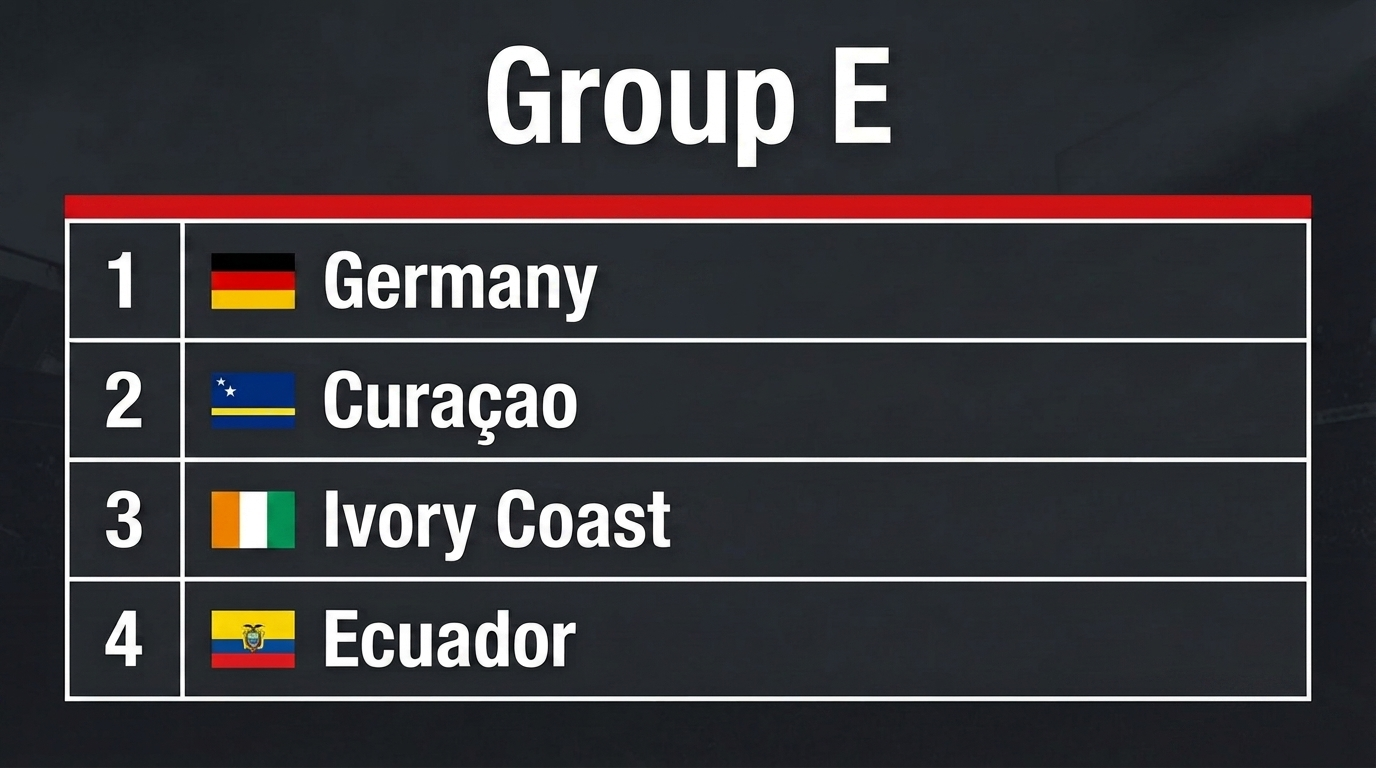
Group E at the 2026 FIFA World Cup delivers one of the tournament’s most vivid contrasts: a four-time world champion rebuilding under new generational leadership, the smallest nation by population and land area ever to qualify for a World Cup, a resurgent African power returning to the tournament after a 12-year absence, and one of South America’s most disciplined and tactically cohesive sides. Germany, Curaçao, Ivory Coast and Ecuador will contest their group across Houston, Philadelphia, Toronto and Kansas City – a mix of central and eastern North American venues that generates no particular geographic advantage for any side.
On paper, Germany appear near-certainties to advance from Group E. The genuinely compelling question – and the one where betting value genuinely lies – is who claims second place from the pool. Ecuador’s record-equalling defensive solidity in CONMEBOL qualifying and Ivory Coast’s AFCON pedigree make their head-to-head fixture in Philadelphia the most important match in the group beyond Germany’s own campaign. Curaçao’s presence, meanwhile, is one of this expanded tournament’s great romantic subplots. For the full tournament picture, visit our World Cup 2026 hub, compare all twelve pools on our World Cup 2026 groups page, and browse the latest World Cup 2026 odds.
Germany: Wirtz, Musiala and the Redemption Mission
 Germany arrive at the 2026 World Cup carrying a burden that would feel alien to any previous generation of Die Mannschaft: consecutive first-round eliminations. Back-to-back group-stage exits in 2018 and 2022 shattered the myth of German tournament invincibility and forced a reckoning that manager Julian Nagelsmann was appointed to resolve. His record since taking over – qualification achieved with five wins from six in UEFA qualifying, a 6-0 thrashing of Slovakia to clinch top spot, and a 4-3 victory over Switzerland in March 2026 – suggests a team building genuine momentum heading into the North American summer.
Nagelsmann has settled on a 4-2-3-1 formation that places extraordinary creative responsibility on his attacking midfield triangle. Florian Wirtz (Liverpool) is the number one ranked attacking midfielder in the world according to FourFourTwo’s 2026 assessment, and while he is still finding his feet at Anfield, his performances in the Germany shirt consistently outstrip his club form – a pattern that has been true since his Leverkusen days. Jamal Musiala (Bayern Munich) – named in the Euro 2024 Team of the Tournament as Germany reached the semi-finals on home soil – is his equally gifted counterpart, capable of taking a match by the scruff of the neck. The fitness of both players will be the single most important factor in assessing Germany’s ceiling at this tournament; a healthy Wirtz-Musiala axis makes Die Mannschaft one of the most frightening prospects in the draw.
Captain Joshua Kimmich (Bayern Munich, 106 caps) plays at right-back rather than his preferred central midfield position, and provides the experience and leadership that anchors Nagelsmann’s system defensively. Kai Havertz (Arsenal) leads the attack. In central defence, the pairing of Jonathan Tah (Bayern Munich) and Nico Schlotterbeck (Borussia Dortmund) is solid if not imperious. The goalkeeping situation remains unresolved following Manuel Neuer’s retirement from international football and Marc-André ter Stegen’s persistent injuries; Oliver Baumann (Hoffenheim) started all six qualifying matches and currently holds the first-choice spot.
Germany’s depth is exceptional. Nick Woltemade, Leroy Sané, Serge Gnabry and Kai Havertz give Nagelsmann genuine options across the front line, and the squad ranks among the strongest in the tournament in terms of second and third-tier quality. Against Curaçao, Ecuador and Ivory Coast, the expectation – and the obligation – is to win the group with three victories.
Ecuador: The Most Defensively Sound Side in South America
 Ecuador’s status as genuine dark horses at the 2026 World Cup is rooted in a qualifying campaign of almost unprecedented defensive excellence. Thirteen clean sheets in eighteen CONMEBOL qualifying matches, only five goals conceded across the entire campaign – a record that equalled the all-time CONMEBOL qualifying low for goals conceded – and a second-place finish behind only Argentina: these are the statistics of a team managed with exceptional tactical clarity by Argentine manager Sebastián Beccacece.
Beccacece, a disciple of the Bielsa school of high-intensity football, has transformed Ecuador into a relentless pressing machine that is also devastatingly organised in its defensive structure. The hallmarks of his side are a compact 4-4-2 low block, rapid transitions through a midfield engineered to win the ball and release attackers in one or two passes, and a centre-back partnership that is, on current form, one of the finest in international football. Willian Pacho (PSG), who was central to PSG’s Champions League triumph in 2025, and Piero Hincapié (Bayer Leverkusen) give Ecuador the kind of elite European club pedigree at the back that would not look out of place in any squad at this tournament.
In central midfield, Moisés Caicedo (Chelsea) is the heartbeat of everything Ecuador do. The £150 million signing from Brighton has established himself as one of the Premier League’s finest midfielders – his 102 duels won in qualifying lead the squad, and his capacity to intercept, drive forward and create makes him irreplaceable in Beccacece’s system. Alongside him, teenage sensation Kendry Páez (Chelsea) – also under contract with the Stamford Bridge club – brings creative flair and technical quality that belies his age, and will be one of the most watched young players at the tournament. Left-back Pervis Estupiñán (AC Milan) adds quality in wide areas.
The honest question hanging over Ecuador is goals. Captain Enner Valencia – the nation’s all-time leading scorer with 48 international goals – is 36 and playing for Pachuca in Liga MX. He scored six times in qualifying and his big-game experience is invaluable, but relying on a veteran striker to shoulder the attacking burden at this level carries risk. Gonzalo Plata (Flamengo) and Kendry Páez provide support, but if Valencia is subdued, Ecuador’s goals may dry up. Defensively, they are a serious outfit. Going forward at this altitude? That requires more faith.
Ivory Coast: Emerse Faé’s Elephants Return After 12 Years
 Ivory Coast’s return to the World Cup finals – their first since 2014 – arrives on the back of arguably the most dramatic AFCON triumph in recent memory. In January 2024, manager Jean-Louis Gasset was sacked mid-tournament after a 4-0 defeat to Equatorial Guinea left Les Éléphants on the brink of elimination. His replacement, Emerse Faé, became the first manager in the history of international football to be appointed during a tournament and then win it – guiding Ivory Coast through the knockout rounds with victories over Senegal, Mali, DR Congo and, in the final, Nigeria 2-1. Faé is, by any measure, a manager who performs under pressure.
His squad blends an exceptional generation of European-based talent with the physical resilience that has always been the Ivorian hallmark. The most prominent name – and the one that will attract the most attention from UK audiences – is Amad Diallo (Manchester United). The 23-year-old winger has been one of the more compelling performers in the Premier League this season, making Ruben Amorim’s wing-back system work before thriving under Michael Carrick’s more attacking setup. His pace, directness and end product in front of goal make him Ivory Coast’s most dangerous attacking weapon, and one of the more exciting wide players at this tournament.
The defensive spine is well-equipped. Evan Ndicka (Roma) and Emmanuel Agbadou (Wolverhampton Wanderers) form a robust centre-back partnership, both thoroughly Premier League and Serie A tested. In midfield, Ibrahim Sangaré (Nottingham Forest) provides the defensive solidity and physicality that allows more creative colleagues to operate higher up the pitch, while Franck Kessié (Al-Ahli) adds experience and quality. Up front, Simon Adingra (Brighton & Hove Albion) offers pace and unpredictability from the left, though his output in the Premier League this season has been limited. Sébastien Haller, when fit, provides a genuine aerial threat in the box – his ability to hold the ball up and bring others into play is a different dimension that Faé can use situationally.
Ivory Coast qualified from CAF Group F without a defeat, finishing one point ahead of Gabon with a campaign built on home fortress results and the growing quality of their European-based contingent. Faé has made clear his ambition knows no bounds: “Why not aim for the final?” he said in April 2026. That is football-manager bravado, but it is rooted in genuine conviction about a squad that, on its best day, can genuinely threaten any opponent at this tournament.
Curaçao: The Smallest Nation in World Cup History, Making the Dream Real
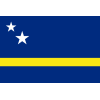 Curaçao’s presence in Group E is, without exaggeration, one of the most remarkable stories in the history of the FIFA World Cup. The Caribbean island – an autonomous constituent country of the Netherlands with a population of approximately 186,000 – is the smallest nation by both population and land area ever to qualify for the tournament. No team in the history of the competition has reached the finals representing so few people.
Their qualification was no fluke. Under veteran Dutch manager Dick Advocaat – who had managed the Netherlands at multiple major tournaments and led Belgium, Russia and Serbia at international level – Curaçao went through the CONCACAF qualifying rounds with a record of seven wins and three draws from ten matches, not losing a single game. They topped their CONCACAF group above Jamaica and Trinidad & Tobago, needing only a goalless draw in Kingston on the final matchday to seal their historic place. Advocaat, sadly, had to resign in February 2026 for personal reasons related to the health of his daughter – a heartbreaking end to his involvement. His successor, Fred Rutten, a former Eredivisie manager with experience in the Netherlands, Germany, Belgium and Israel, takes over for the tournament itself.
The squad is composed predominantly of Eredivisie-based players, many of them Dutch-born of Curaçaoan descent, with strong links to the Netherlands’ football ecosystem. Captain Leandro Bacuna – a Premier League and Championship veteran (Aston Villa, Cardiff City) – brings experience from a long European career and remains the heartbeat of the side. Juninho Bacuna led the team in duels won across the qualifying campaign. Top scorer Rangelo Janga provides the attacking threat with his record of double-digit scoring returns in CONCACAF competition. Gervane Kastaneer (five qualifying goals) is another attacking option with meaningful club experience in European football.
The honest reality of this campaign is that Curaçao will need something close to a miracle to take points from Germany, Ecuador and Ivory Coast – all of whom carry considerably superior individual quality across their squads. The true measure of success for Rutten’s side will not be points but dignity: playing three competitive fixtures on football’s biggest stage, representing an island nation of 186,000 people, and showing the world that CONCACAF’s smaller territories belong here.
Group E Fixtures
All six Group E fixtures take place between 14 and 25 June 2026, spread across Houston, Philadelphia, Toronto and Kansas City. UK kick-off times are listed below – venues span US Central Time (CDT = BST −6) and US/Canadian Eastern Time (EDT = BST −5). BBC and ITV, with streaming on BBC iPlayer and ITVX, will carry matches – final broadcast allocations confirmed closer to the tournament.
| Date | UK Time | Match | Venue |
| Sun 14 June 2026 | 18:00 BST | Germany vs Curaçao | NRG Stadium, Houston |
| Mon 15 June 2026 | 00:00 BST | Ivory Coast vs Ecuador | Lincoln Financial Field, Philadelphia |
| Sat 20 June 2026 | 21:00 BST | Germany vs Ivory Coast | BMO Field, Toronto |
| Sun 21 June 2026 | 01:00 BST | Ecuador vs Curaçao | Arrowhead Stadium, Kansas City |
| Thu 25 June 2026 | 21:00 BST | Curaçao vs Ivory Coast | Lincoln Financial Field, Philadelphia |
| Thu 25 June 2026 | 21:00 BST | Ecuador vs Germany | MetLife Stadium, East Rutherford (New York) |
The standout fixture for neutral UK viewers is undoubtedly the Ivory Coast vs Ecuador opener in Philadelphia, which kicks off at midnight BST on Saturday night into Sunday. The final matchday on 25 June sees both games kick off simultaneously at 9pm BST. Germany’s group finale is at MetLife Stadium in New Jersey – the venue for the World Cup final itself on 19 July.
Group E Odds & Predictions
The Group E winner market is one of the most lopsided in the tournament. Germany are available at around 3/10 to 1/3 to win the group – odds that imply a probability of approximately 75% and reflect a near-universal consensus that Nagelsmann’s side will finish first. After back-to-back group-stage exits in 2018 and 2022, no one inside the Germany camp will be taking Group E for granted, but the quality gap between them and the remaining three sides – particularly a Curaçao making their World Cup debut – is substantial.
The real betting interest lies in the race for second place. Ecuador are available at around 3/1 to 7/2 – a price that effectively makes them 7/4 or thereabouts to finish in the top two and qualify automatically. Their qualifying defensive record is extraordinary: 13 clean sheets, five goals conceded in 18 CONMEBOL matches. Moisés Caicedo is arguably the finest midfielder in the tournament outside of the top-eight seeded nations, and their centre-back pairing of Pacho and Hincapié is world-class. The pivotal fixture is their group opener against Ivory Coast in Philadelphia on the night of 14 June – win that, and Ecuador have one foot in the Round of 32 before facing Curaçao and Germany.
Ivory Coast are available at around 6/1 to 7/1 to win the group, and around 5/4 to qualify from the group. Their AFCON pedigree under Faé is impressive, and the Premier League quality of Amad Diallo, Agbadou and Sangaré gives them a familiar European football DNA that should translate on North American pitches. However, their 12-year absence from the World Cup is a nagging concern: major tournament experience at this level matters in tight games, and Ivory Coast simply don’t have it in the way that Ecuador and Germany do.
Our prediction: Germany top the group with maximum or near-maximum points; Ecuador qualify in second. The Ivory Coast vs Ecuador fixture on 14 June is the group’s most important match – we expect Ecuador’s defensive discipline and Caicedo’s dominance of midfield to edge a narrow result. The standout value play in Group E is Ecuador to qualify from the group at around 4/7 – a strong short-price proposition given the evidence of their qualifying campaign. For those seeking a longer price, Ivory Coast to qualify at 5/4 offers genuine upside if Faé’s side can take the points they need from their opener.
Stay across squad news and injury updates from now until June on our World Cup 2026 hub, explore how Group E fits into the wider bracket on our World Cup 2026 groups page, and check the latest market prices on our dedicated World Cup 2026 odds hub.
Group E has everything: a four-time world champion chasing tournament redemption, South America’s most disciplined defensive unit, an African side powered by Manchester United and Nottingham Forest talent, and history’s smallest World Cup nation. The qualifying drama starts on 14 June – bookmark this page for odds updates and team news as we approach the tournament.