

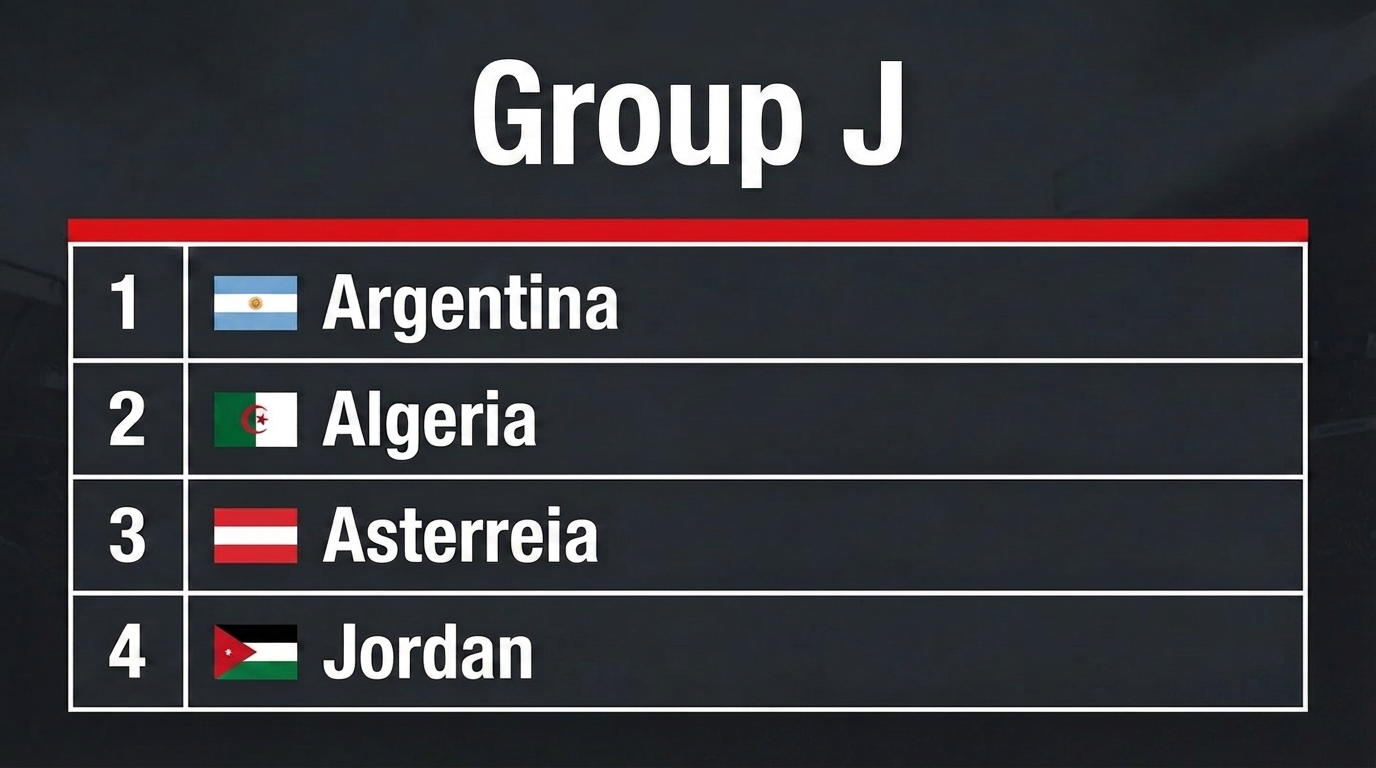
 Group J at the 2026 FIFA World Cup contains one of international football’s most compelling storylines: the defending champions meet three opponents with points to prove and history to settle. Argentina, three-time world champions and 2022 title holders under manager Lionel Scaloni, head a group that also features Austria, returning to the World Cup for the first time since 1998 under former Manchester United interim Ralf Rangnick; Algeria, back on the global stage for the first time in 12 years with Riyad Mahrez leading a squad hungry to match their 2014 round-of-16 performance; and Jordan, making their historic first-ever World Cup appearance. Beneath the obvious headline of Argentina’s title defence, the sub-plot between Austria and Algeria crackles with extraordinary historical resonance – their group finale is the first meeting between the two nations at a World Cup since the infamous Disgrace of Gijón in 1982.
For a full tournament picture, explore our World Cup 2026 hub, compare Group J against all other pools on our World Cup 2026 groups page, and check the latest Group J odds and outright markets on our World Cup 2026 odds page.
Argentina: Messi’s Final Dance and Scaloni’s Quest for History
 The most discussed question in world football ahead of the 2026 World Cup is not whether Argentina will qualify from Group J – that is taken as given – but whether Lionel Messi will be in the squad at all. At 38 years old and playing his club football at Inter Miami, Messi cast doubt on his participation in September 2025, saying the most logical outcome of his age was that he would not feature. Manager Lionel Scaloni has repeatedly confirmed no decision has been made, stating only that Messi has his place guaranteed if he commits. As of April 2026, Messi was among 21 players reportedly locked into Scaloni’s planning according to ESPN Argentina, though his exact status remains officially undecided. The stakes are immense: Scaloni wants to become the first manager since Italy’s Vittorio Pozzo in 1934 and 1938 to win back-to-back World Cups, and Argentina want to become only the third nation after Italy and Brazil to defend the title.
Even setting Messi aside, this squad is formidable. Emiliano Martínez (Aston Villa) is one of the world’s best goalkeepers and the hero of the 2022 penalty shootout final. Cristian Romero (Tottenham Hotspur) and Lisandro Martínez (Manchester United), both Premier League-based, form the central defensive partnership – when fit, among the best in the tournament. The midfield triangle of Alexis Mac Allister (Liverpool), Rodrigo De Paul (Inter Miami) and Enzo Fernández (Chelsea) provides exceptional balance between defensive intelligence, ball-carrying and technical precision. Up front, Lautaro Martínez leads the line with 20-plus league goals for Inter Milan, while Julián Álvarez brings the versatile off-the-shoulder running that tormented opponents at Qatar 2022. Injuries have ruled out Giovani Lo Celso (torn quadriceps) and Valentín Carboni (knee), but emerging talents Franco Mastantuono (Real Madrid) and Nico Paz represent the next generation pushing for minutes.
Argentina topped CONMEBOL qualifying with 38 points from 18 matches – 12 wins, 2 draws, 4 losses – finishing ahead of Ecuador, Colombia and Uruguay. Their form and collective tournament experience make them the clearest group winner in this pool.
Austria: Rangnick’s Red Bull Revolution Returns to the World Stage
 Austria’s qualification for the 2026 World Cup – their first since 1998 – is a landmark achievement driven almost entirely by one man’s tactical vision. Manager Ralf Rangnick, 67, the German who previously managed Schalke, Hoffenheim, RB Leipzig and held the short-term interim role at Manchester United in 2021-22, has built an Austrian national team in the image of the Red Bull pressing philosophy he spent decades developing across Europe. The influence is woven through the squad: players educated within the Red Bull system at Salzburg and Leipzig account for the spine of the side, and the high-intensity gegenpressing style that Rangnick popularised is the tactical identity Austria bring to North America.
They qualified comfortably, topping UEFA Group H with 19 points from eight matches – six wins, one draw, one defeat – including a 10-0 demolition of San Marino in October 2025. David Alaba (Real Madrid, captain) is the marquee name: a versatile defender who has won four European Cup titles at club level and has more than 120 Champions League appearances. Now 34, Alaba’s leadership and intelligence organising the back four remain central to how Rangnick sets up. Marcel Sabitzer (Borussia Dortmund) is the creative fulcrum in a number-ten role, having come through the Red Bull system at Leipzig before spells at Bayern Munich and Manchester United. Konrad Laimer (Bayern Munich) brings relentless pressing and ball-winning quality in the double pivot, while Christoph Baumgartner adds dynamic width. The goalkeeper debate between Patrick Pentz and Alexander Schlager is Rangnick’s most pressing selection question.
The elephant in the room is Marko Arnautović (37 years old by the tournament), Austria’s all-time top scorer with 47 goals and their most capped player with 132 appearances. He is ageing and physically limited over 90 minutes in North American summer heat, but his experience and aerial threat make him difficult to leave out entirely. Rangnick must manage him carefully across three matches.
The historical subplot adds extra edge to Austria’s group: the final-day clash with Algeria in Kansas City is the first meeting between the two nations at a World Cup since they were involved – from opposite sides – in the Disgrace of Gijón in 1982, when West Germany beat Austria 1-0 in a result that conveniently eliminated Algeria from the tournament and prompted FIFA to mandate simultaneous final group-stage matches from that point onwards.
Algeria: Mahrez, Amoura and the Return of the Desert Foxes
 Algeria’s absence from the World Cup since their outstanding 2014 campaign – where they beat South Korea, drew Russia and lost only 2-1 to eventual champions Germany after extra time in the round of 16 – ends in 2026 with a squad carrying genuine ambition alongside notable vulnerabilities. Manager Vladimir Petković, 62, the Bosnian-Swiss tactician who previously led Switzerland to the 2018 World Cup and multiple major European Championship campaigns, was appointed in February 2024 after Algeria’s second consecutive AFCON group-stage exit. Under Petković they topped CAF Group G with 22 points – seven wins, one draw, two defeats, 24 goals scored, seven conceded – to qualify comfortably. At AFCON 2026 in Morocco, they reached the quarter-finals before a 2-0 defeat to Nigeria.
The spine of the squad is clear. Riyad Mahrez (Al-Ahli, captain) is the iconic figure: the former Leicester City PFA Players’ Player of the Year in 2016, Premier League and Champions League winner with Manchester City, and the man whose creativity, dribbling and dead-ball delivery make Algeria a different proposition when he is on form. Now 35, this is almost certainly his World Cup swansong. Mohamed Amoura (Lyon) is the explosive young attacker who scored 10 goals in qualifying – the joint-highest return in CAF – including a hat-trick against Mozambique and a brace against Somalia. He gives Algeria a direct, physical goal threat that Mahrez alone could not provide. Ismael Bennacer is the midfield pivot whose pressing and passing intelligence would significantly elevate Algeria’s structure when fit. Ryan Aït-Nouri (Wolverhampton Wanderers, the sole Premier League representative) provides width from left-back and a direct attacking outlet from deep.
Petković was candid after the draw: “Argentina is the best. We [Algeria], along with Austria, and even Jordan, are doing everything to secure second place.” That is the honest framing of their task. Against Jordan they will be heavy favourites; the Austria match in Kansas City on 28 June, laden with the ghost of 1982, is the fixture that decides their fate.
Jordan: History Made, Now the Real Test Begins
 Jordan’s qualification for the 2026 World Cup – their first in nine previous attempts – stands as the most significant moment in the history of Jordanian football. They sealed their place on 5 June 2025 with a 3-0 victory away at Oman, having finished second in AFC Group B behind South Korea across eight competitive qualifying matches, going unbeaten in four and drawing four. Manager Jamal Sellami, 55 – a former Moroccan international midfielder who previously managed Raja Casablanca and won the 2018 African Nations Championship with Morocco – was appointed in 2024 after his predecessor departed for family reasons. Sellami has lost only twice in 12 matches in charge and led Jordan to the FIFA Arab Cup final in December 2025, where they went unbeaten through the group stage and knockout rounds before losing 3-2 to Morocco in the final after extra time. His appointment has been an unqualified success: he became the first manager to take Jordan to the World Cup and the Arab Cup final in his first international management job outside Moroccan football.
The squad is overwhelmingly domestic-based, which limits the ceiling of what Jordan can achieve against European and South American quality. Captain Musa Al-Taamari (Rennes) is the standout name – the first Jordanian to play in Ligue 1, a player who scored and assisted in Jordan’s historic 2-0 AFC Asian Cup semi-final victory over South Korea in 2024, and the only regular in a top European league. His pace, directness and ability to beat defenders in one-on-one situations make him the most dangerous threat Jordan possess. In defence, Yazan Al-Arab (FC Seoul) is the most experienced centre-back. Goalkeeper Yazeed Abu Laila started every qualifying fixture and will be between the posts in North America.
Jordan’s post-qualifying form raised concerns: six matches before the Arab Cup brought just one win. But the December Arab Cup run – winning five matches in a row and conceding only two goals before the final – demonstrated that a settled, organised Sellami side is a very different proposition to a transitional team still finding its shape. Argentina, Algeria and Austria are all considerably stronger on paper, but Jordan’s discipline in a low defensive block, combined with Al-Taamari’s counterattacking threat, gives them a fighting chance of keeping the scoreline respectable in every fixture and of causing a surprise against a distracted or rotated opponent.
Group J Fixtures
Group J runs from 16 June to 27 June 2026 across three venues: Arrowhead Stadium in Kansas City, AT&T Stadium in Arlington (Dallas area) and Levi’s Stadium in Santa Clara (San Francisco Bay Area). All Group J kick-offs are late-night or early-morning viewing for UK audiences – a pattern that reflects the CDT and PDT time zones. UK times confirmed by Sky Sports and FourFourTwo official BST listings. Coverage across BBC and ITV, with streaming on BBC iPlayer and ITVX.
| Date | UK Time | Match | Venue |
| Wed 17 June 2026 | 02:00 BST | Argentina vs Algeria | Arrowhead Stadium, Kansas City |
| Wed 17 June 2026 | 05:00 BST | Austria vs Jordan | Levi’s Stadium, Santa Clara |
| Mon 22 June 2026 | 18:00 BST | Argentina vs Austria | AT&T Stadium, Arlington (Dallas) |
| Tue 23 June 2026 | 04:00 BST | Jordan vs Algeria | Levi’s Stadium, Santa Clara |
| Sat 28 June 2026 | 03:00 BST | Algeria vs Austria | Arrowhead Stadium, Kansas City |
| Sat 28 June 2026 | 03:00 BST | Jordan vs Argentina | AT&T Stadium, Arlington (Dallas) |
The only Group J fixture at a UK-friendly time is Argentina vs Austria on 22 June at 6pm BST – the prime-time slot that British viewers will circle in their guides. The Argentina vs Algeria opener in Kansas City kicks off at 2am BST, requiring a late-night commitment. The simultaneous group finale on the morning of Saturday 28 June – both matches at 3am BST – is significant: it is the first time Algeria and Austria have had their World Cup fates decided in real time since 1982, and FIFA’s simultaneous kick-off rule exists in part because of the collusion their predecessors inflicted on Algeria 44 years ago.
Group J Odds & Predictions
Argentina are the heaviest non-Spain favourites to win their group at the 2026 World Cup. Argentina to win Group J are available at around 1/3 to 2/7 – an implied probability of around 70-75% that fully reflects the defending champions’ quality across every department. With Lautaro Martínez, Enzo Fernández and Emiliano Martínez all in their prime, the Albiceleste’s group-stage qualification is not seriously in doubt. The only scenario that changes the calculus is Messi’s absence and a catastrophic injury to two or three first-choice players simultaneously.
Austria to qualify from the group are available at around 4/5 to evens – representing a 50-55% implied probability for the second qualifying spot. That pricing is broadly fair. Rangnick’s side are the better organised and technically superior team against Algeria and Jordan, and their pressing system can cause Argentina problems for stretches even if winning that fixture remains unlikely. The key is their opener against Jordan in Santa Clara: Austria to win vs Jordan are available at around 1/2 to 4/7 across most UK bookmakers, which represents the foundation of their qualification. Lose that and the road gets considerably harder.
Algeria to qualify are available at around 5/2 to 3/1. The market paints them as the clear third team in this group, but the argument for narrowing that gap is credible. They beat Jordan in qualifying if not directly – they are comfortably superior on paper – and a Mahrez-inspired Algeria could match Austria if both sides arrive at the group finale needing the win. The historical echo of 1982 cuts both ways: Algeria will be supremely motivated; Austria will be equally aware they cannot afford another moment that history remembers badly.
Julián Álvarez for Group J top scorer at around 7/2 to 4/1 is the standout individual betting angle. With Messi’s status uncertain, Álvarez is likely to carry the greater goalscoring burden across three matches against Algeria, Austria and Jordan. His combination of movement, pressing quality and finishing – demonstrated in both the 2022 World Cup and his club career – makes him the most likely individual standout from Argentina’s Group J campaign.
Our prediction: Argentina win the group; Austria qualify in second. Algeria’s quality and Mahrez’s experience give them a puncher’s chance, but Austria’s organised pressing system and the depth in Rangnick’s midfield makes them the more reliable second-place finisher across three competitive matches.
Track all Group J squad news, injury updates and the latest betting markets on our World Cup 2026 hub, see how the group compares to the other eleven pools on our World Cup 2026 groups page, and find the best available Group J prices on our World Cup 2026 odds page.
Group J offers the 2026 World Cup’s most historically layered group – Messi’s swansong, Rangnick’s pressing system, Algeria’s 44-year wait for justice against Austria, and Jordan’s incredible debut. The Argentina vs Austria fixture at 6pm BST on 22 June is the essential UK viewing occasion of this group’s ten days.