

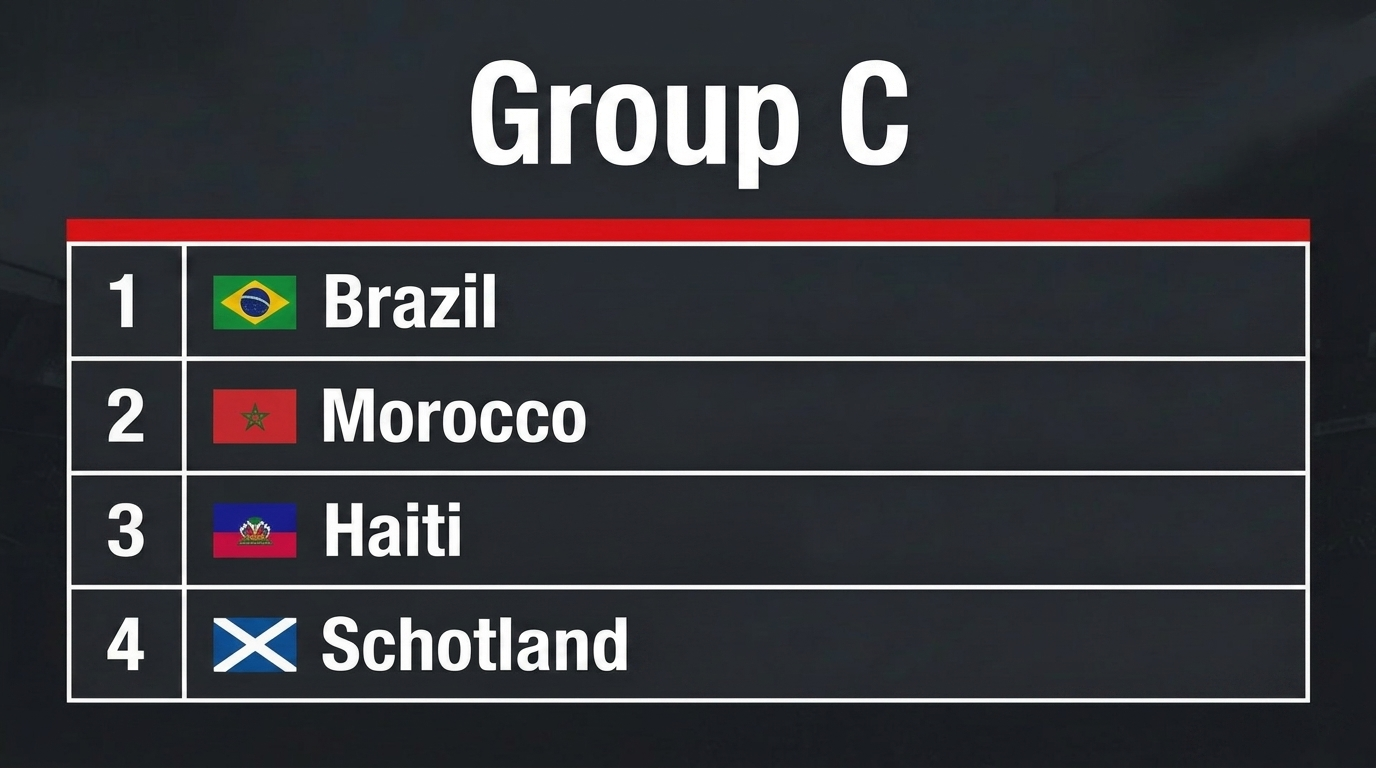
Group C at the 2026 FIFA World Cup is one of the most compelling pools in the entire draw. Brazil, the five-time world champions and pre-tournament favourites in many markets, headline a group that also features Africa’s finest side in Morocco, a Scotland team ending a 28-year World Cup exile, and Caribbean debutants Haiti making only their second-ever appearance at the tournament. All six fixtures will take place across the eastern United States, with Brazil’s matches spread across MetLife Stadium in New Jersey, Lincoln Financial Field in Philadelphia, and Hard Rock Stadium in Miami.
On paper, Brazil and Morocco look nailed on to claim the two automatic qualification spots, but the bookmakers’ margins mask a more interesting question: can Scotland – armed with arguably their most talented squad in decades – produce the sort of group-stage shock that would send the Tartan Army into delirium? For punters looking across the World Cup 2026 groups, Group C offers genuine value beyond the obvious. For the full picture of the tournament and the latest World Cup 2026 odds, keep reading – and be sure to visit our World Cup 2026 hub for all the latest news and analysis.
Brazil: Galáctico Talent, Unfinished Business
 No nation carries more expectation into a World Cup than Brazil, and the 2026 edition – the first on North American soil since 1994, when the Seleção last lifted the trophy there – feels loaded with significance. Five world titles, yet nothing since 2002: the drought haunts a country that regards anything short of glory as failure.
The appointment of Carlo Ancelotti as manager was a coup by any measure. The Italian brought five Champions League titles and a calm, authoritative presence to a dressing room that had grown fractious under Dorival Júnior. Ancelotti’s record in his first months in charge – four wins, two draws, two defeats from eight matches – does not yet inspire unbridled confidence, and a friendly defeat to Japan in March 2026 exposed a defensive fragility that will need addressing. Brazil finished only fifth in CONMEBOL qualifying, a statistic that strips the gilt from their odds. That said, Ancelotti knows his squad. Many of these players won La Liga and the Champions League under him at Real Madrid, and that institutional trust is worth something.
The attacking roster remains genuinely terrifying. Vinícius Júnior (Real Madrid) is the standard-bearer – a Ballon d’Or runner-up who has already scored eight goals and provided 11 assists in all competitions this season. Raphinha (Barcelona) had a remarkable 2024-25 campaign with 34 goals and 26 assists, and while his output has dipped slightly, he remains elite. Matheus Cunha (Manchester United) has emerged strongly, scoring five goals in 12 Premier League appearances since December, giving Ancelotti a high-energy option in the final third. The Bournemouth wonderkid Rayan has earned his first call-up following impressive performances in the Premier League this term. Midfield is anchored by the dependable pairing of Bruno Guimarães (Newcastle) and Casemiro (Manchester United), while Alisson (Liverpool) is likely to start in goal, though questions persist about the Liverpool keeper’s form this season. Rodrygo‘s knee injury ruling him out is a genuine blow to Ancelotti’s depth in wide areas.
The key question for Brazil is whether Ancelotti can organise a watertight defence in time. The back line – likely built around Marquinhos and Arsenal’s Gabriel Magalhães – conceded four goals against Argentina in qualifying and was opened up repeatedly by Japan’s counter-attacks. Opponents will study that tape obsessively.
Morocco: New Boss, Same Fearsome Ambition
 Morocco’s journey to Qatar 2022 – finishing fourth and becoming the first African nation to reach a World Cup semi-final – redefined what African football could achieve at the highest level. The Atlas Lions beat Spain and Portugal on their way to the last four, stunning the world with their defensive discipline, set-piece menace and electric transitions. The task for 2026 is to show that run was not a one-off.
There is, however, significant upheaval to navigate. Walid Regragui – the architect of that Qatar miracle – quit after the Africa Cup of Nations, which Morocco hosted in January 2026. The Atlas Lions lost the AFCON final to Senegal, though the result was subsequently awarded to Morocco by CAF after Senegal walked off the pitch to protest a penalty decision. Regragui’s replacement is Mohamed Ouahbi, a youth specialist who led Morocco’s Under-20 side to the FIFA U-20 World Cup title – only the second African nation ever to do so. His promotion from the youth ranks is an intriguing gamble; it is his first senior managerial role, but his record with younger players suggests a boldness that could translate. Morocco drew 1-1 with Ecuador and beat Paraguay 2-1 in their March 2026 friendlies under Ouahbi – modest but positive early signs.
The squad retains world-class quality throughout. Achraf Hakimi (PSG) is one of the finest attacking full-backs on the planet, having registered 28 goals under Luis Enrique at Paris Saint-Germain, including contributions in the Champions League final. Brahim Díaz (Real Madrid) is the creative fulcrum, though he will carry the memory of his missed penalty in the AFCON final into the summer. Yassine Bounou (Al Hilal) is a reliable presence in goal. In midfield, Sofyan Amrabat (Real Betis) – the superstar of Morocco’s Qatar 2022 campaign – is recovering from injury concerns, while the 21-year-old Bilal El Khannouss (Stuttgart, on loan from Leicester City) has been one of the more exciting young midfielders in the Bundesliga this season. The squad also features Noussair Mazraoui and Issa Diop in defence.
Morocco completed their CAF qualifying campaign unbeaten, winning all eight games, scoring 22 and conceding just twice. That record is extraordinary. Ouahbi inherits a team that knows how to win – the challenge is rebuilding tactical shape quickly enough for June.
Scotland: The Tartan Army’s Moment of Truth
 For Scottish football supporters of a certain age, the 28-year wait for a World Cup return has been one of the game’s great sporting agonies. The scenes at Hampden Park on 18 November 2025, when Scott McTominay‘s outrageous overhead bicycle kick opened the scoring against Denmark – and Scotland eventually triumphed 4-2 in one of the most dramatic qualifier deciders in recent memory – will live long in the memory of the Tartan Army. Now comes the hard part.
Steve Clarke has been in charge since 2019 and has now become the most-capped manager in Scotland’s history, leading them to two European Championships and this World Cup. His tactical blueprint is well-established: a compact 3-4-2-1 that defends deep and hits quickly on the break, making Scotland extraordinarily difficult to score against. The system suits a squad whose greatest strength lies in the engine room. Clarke will be the first man to lead Scotland at three consecutive major tournaments – a testament to what he has built.
McTominay is the heartbeat of this team. The Napoli midfielder – Serie A MVP last season – has evolved from a functional defensive presence into a genuinely dynamic box-to-box threat, capable of devastating late runs into the area. John McGinn (Aston Villa, captain) provides the legs, leadership and guile that make Clarke’s system tick. Billy Gilmour (Napoli) offers technical precision as the holding midfielder, while Lewis Ferguson (Bologna) – Coppa Italia winner in 2025 – brings defensive nous. Captain Andy Robertson (Liverpool) at left-back provides experienced leadership and quality from deep, and his link play with McTominay on the left channel could be crucial in tight fixtures.
The concern for Clarke is the striker position. Neither Lyndon Dykes nor Che Adams (Torino) is a genuinely elite international finisher, and Lawrence Shankland‘s fitness remains a question mark following a hamstring concern. Scotland have never progressed past the group stage in eight previous World Cup appearances – but this squad, with McTominay in the form of his life and the midfield depth to compete with anyone, represents their best chance to change that narrative.
Critically, Scotland’s opening fixture – against Haiti rather than one of the group’s heavyweights – gives them the opportunity to bank three points and approach the Morocco and Brazil games with genuine belief rather than desperation. The Scots face Brazil in the final group game in Miami, a match which, depending on results, could carry enormous weight.
Haiti: Caribbean Underdogs, 52 Years in the Making
 Haiti’s last World Cup appearance was in 1974, when the Caribbean nation was eliminated after consecutive defeats to Italy, Poland and Argentina. Fifty-two years later, they return as the group’s rank outsiders – but with a cohesion and tactical clarity forged under their French manager Sébastien Migné, a former assistant at the 2022 World Cup with Cameroon, that should not be entirely dismissed.
Haiti qualified by winning their CONCACAF qualifying group, and the manner of their qualification suggests a resilient, well-organised side. Their top scorer is Duckens Nazon, 32, who was joint-top scorer in CONCACAF qualifying with six goals – including a hat-trick scored from the bench in a remarkable 3-3 draw at Costa Rica. Nazon’s ability to change games from the bench gives Migné a tactical option that can be exploited against tired defences.
Haiti currently sit 83rd in the FIFA world rankings – ahead of only New Zealand among the 48 qualified nations. Their squad is composed largely of players from MLS and the lower reaches of European football, which makes them significant underdogs against Brazil and Morocco in particular. However, Migné’s experience in elite tournament football at the 2022 World Cup and his understanding of how to set up a side defensively could yield a point or two. The opening fixture against Scotland in Boston is their most realistic opportunity to cause a surprise.
For Haiti, the tournament is in many respects a victory already secured. Representing a nation that has endured profound hardship in recent years, their players carry the hopes of an entire country onto the pitch. Haiti will be guided by pragmatism – compact defensive shape, quick transitions – and any points they accumulate will represent genuine achievement. Bookmakers have them at extraordinary length: even a solitary point would represent a minor miracle given the company they keep in Group C.
Group C Fixtures
All six Group C fixtures take place across the eastern United States between 13 and 24 June 2026. UK kick-off times are listed below. Coverage is expected across BBC and ITV, with streaming via BBC iPlayer and ITVX – full broadcast allocations will be confirmed closer to the tournament.
| Date | UK Time | Match | Venue |
| Sat 13 June 2026 | 23:00 BST | Brazil vs Morocco | MetLife Stadium, New Jersey |
| Sun 14 June 2026 | 02:00 BST | Haiti vs Scotland | Gillette Stadium, Boston |
| Fri 19 June 2026 | 23:00 BST | Scotland vs Morocco | Gillette Stadium, Boston |
| Sat 20 June 2026 | 01:30 BST | Brazil vs Haiti | Lincoln Financial Field, Philadelphia |
| Wed 24 June 2026 | 23:00 BST | Scotland vs Brazil | Hard Rock Stadium, Miami |
| Wed 24 June 2026 | 23:00 BST | Morocco vs Haiti | Mercedes-Benz Stadium, Atlanta |
Note that Scotland’s opening fixture kicks off in the early hours of Sunday morning UK time – dedicated supporters will need to keep the kettle on. The final two group fixtures on 24 June kick off simultaneously, as per FIFA protocol to prevent tactical collusion.
Group C Odds & Predictions
The Group C winner market is almost entirely Brazil’s to lose. The Seleção are available at around 4/9 to top the group – odds implying roughly an 80% probability of finishing first. That feels on the short side given Ancelotti’s defensive questions and a defeat to Japan as recently as March, but Brazil’s attacking firepower through Vinícius Júnior, Raphinha and Matheus Cunha is genuinely historic in its depth, and the bookmakers are simply reflecting reality.
Morocco are around 7/2 to 9/2 to win the group – a price that looks genuinely tempting. Their CONCACAF qualifying record of eight wins from eight, 22 goals scored and two conceded is the kind of form that makes tactical analysts nervous. New manager Mohamed Ouahbi showed encouraging results with a 2-1 win over Paraguay in March. If Brazil’s defensive fragility is exposed in their opening fixture at MetLife Stadium, Morocco could top the group – and at nearly five times your money, that’s a live bet.
For Scotland to qualify from the group, you can find odds of 13/8 to 2/1 – value we would lean towards given the expanded 48-team format, where eight of the twelve third-place finishers also progress. Clarke’s side need only to manage their fixture schedule intelligently: win against Haiti, bank a point somewhere against Morocco or Brazil, and trust the numbers. Scotland’s midfield quality – McTominay, McGinn, Gilmour, Ferguson – is comparable to most in the tournament, and their tactical discipline under Clarke means they are unlikely to be embarrassed even against the Seleção.
Our prediction: Brazil and Morocco qualify automatically, with Scotland finishing third and advancing as one of the better third-placed sides. Haiti are likely to struggle against this company, though Migné’s experience of tournament football means they will make opponents work for every goal. For outright betting, Brazil to win the group at 4/9 is too short; Morocco group winner at 7/2 is the standout value play in Group C.
Head to our World Cup 2026 hub for tips across all twelve groups, and browse the full World Cup 2026 betting odds page for the latest group and tournament markets from all major UK bookmakers. For a broader look at how Group C fits into the wider draw, see our guide to all the World Cup 2026 groups.
Group C delivers everything the expanded World Cup promises: a genuine superpower in Brazil, a proven giant-killer in Morocco, a romantic story in Scotland’s long-awaited return, and the pure underdog spirit of Haiti. Bookmark this page – we will update our predictions and odds analysis as squad announcements and pre-tournament form develop through May and into June.