

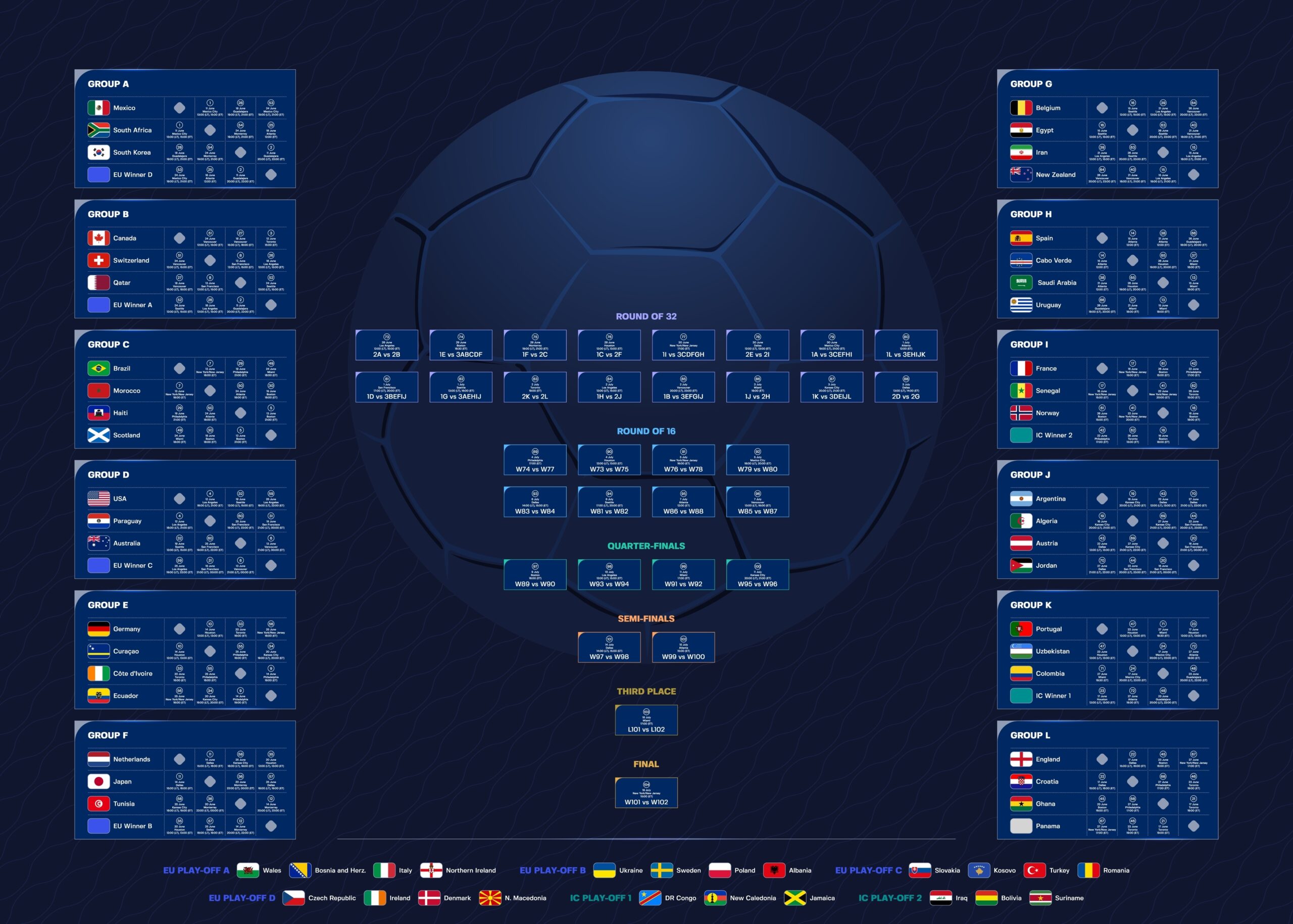
 The 2026 FIFA World Cup is the biggest tournament in football history – 48 teams, 12 groups, 104 matches, 39 days, three countries, and a knockout bracket that delivers four extra matches on the road to the final at MetLife Stadium in New Jersey on 19 July. From England’s Group L opener against Croatia to Argentina’s first defence of their title and Norway’s Erling Haaland leading a perfect-qualifying-record side into Group I against France, there has never been a World Cup wall chart more worth having on your wall. Our World Cup 2026 wall chart gives you all 12 groups, the complete knockout bracket, every group stage matchday and the pathway to the final – print it, fill in the results after every set of fixtures and track exactly who is heading where through the bracket. For the full match schedule, visit our World Cup 2026 fixtures guide. For outright odds and tournament betting markets, see our World Cup 2026 betting hub. If you’re organising an office sweepstake, our World Cup 2026 sweepstake guide has everything you need to set one up fairly.
Free Printable World Cup 2026 Wall Chart – Download Your PDF
Our World Cup 2026 wall chart PDF is designed to be printed on a single A3 or A2 sheet – landscape orientation works best – and includes space to fill in every group stage result, track the points table in real time, and follow each team’s knockout path from the Round of 32 through to the final. The chart is sized to fit standard UK poster frames, making it the easiest way to follow all 104 matches of the tournament without switching between multiple apps or browser tabs.
The PDF includes the full group stage draw – all 12 groups with the four teams in each, the group stage match grid with dates and kick-off times in BST, the complete knockout bracket showing how groups feed into the Round of 32, Round of 16, quarter-finals and semi-finals, space to write in goalscorers and results, and a final match box on 19 July at MetLife Stadium. Whether you’re following England’s run, tracking Haaland’s Golden Boot charge or keeping an eye on Scotland’s Group C challenge against Brazil and Morocco, the wall chart keeps everything in one place.
The chart is free to download and print. No registration required. It is updated to reflect the final 48-team draw as confirmed on 1 April 2026 following the completion of the inter-confederation play-offs, with Iraq’s 2-1 victory over Bolivia completing the full tournament field. For the complete groups guide, visit our World Cup 2026 groups guide.
How to Use Your Wall Chart – Tips for Getting the Most From It
The new 48-team format makes the 2026 World Cup wall chart slightly more complex than previous editions, because the bracket does not follow a straightforward pattern. Here is what you need to know to fill it in correctly.
At the group stage, note that the top two teams from each group progress automatically, but eight of the twelve third-placed finishers also advance – specifically the eight best third-placed teams across all groups, ranked by points, then goal difference, then goals scored. This means even a group-stage exit is not confirmed until all final matchdays have been completed, and every point matters right to the end. Fill in results, points and goal difference after each matchday to track third-place standings accurately.
In the Round of 32, the bracket is not a simple mirror of the draw. FIFA established two separate pathways for the knockout stage, designed to ensure that Spain and Argentina – ranked first and second at the draw – cannot meet before the final if both win their groups. England (Pot 1, ranked fourth) and France (Pot 1, ranked third) are also in opposite pathways. Use the pathway markers on our chart to trace which Round of 32 match feeds into which Round of 16 fixture – this matters particularly for England supporters calculating a potential semi-final opponent.
Mark group-stage results in one colour, knockout results in another – this makes the chart dramatically easier to read in the tournament’s later stages, when the bracket becomes dense with information.
All 12 Groups at a Glance
Here is the complete 48-team draw across all 12 groups, confirmed following the final inter-confederation play-offs on 1 April 2026. Group A opens the tournament on 11 June with Mexico vs South Africa at the Estadio Azteca in Mexico City. Group L contains England and Scotland’s major opponents, and is the group with the most direct relevance for UK viewers.
| Group | Team 1 | Team 2 | Team 3 | Team 4 |
| A | Mexico | South Korea | South Africa | Czechia |
| B | Canada | Switzerland | Qatar | Bosnia and Herzegovina |
| C | Brazil | Morocco | Scotland | Haiti |
| D | USA | Australia | Paraguay | Türkiye |
| E | Germany | Ecuador | Ivory Coast | Curaçao |
| F | Netherlands | Japan | Tunisia | Sweden |
| G | Belgium | Iran | Egypt | New Zealand |
| H | Spain | Uruguay | Saudi Arabia | Cape Verde |
| I | France | Senegal | Norway | Iraq |
| J | Argentina | Austria | Algeria | Jordan |
| K | Portugal | Colombia | Uzbekistan | DR Congo |
| L | England | Croatia | Panama | Ghana |
Scotland are in Group C alongside 2022 semi-finalists Brazil, 2022 quarter-finalists Morocco and debutants Haiti – the tournament’s most challenging group for a side ranked 44th in the world. England are in Group L alongside Croatia – their 2018 semi-final opponents and 2022 group-stage rivals – plus Panama and Ghana, giving Thomas Tuchel’s side a clear path to qualification. The four World Cup debutants are Cape Verde, Curaçao, Jordan and Uzbekistan. First-time qualifiers also include Haiti and Bosnia and Herzegovina, while Italy are the most notable absentee – eliminated by Bosnia on penalties in the UEFA play-off final on 31 March 2026.
The Knockout Bracket – From Round of 32 to the New Jersey Final
The 2026 World Cup introduces a Round of 32 for the first time – a new stage between the group phase and the Round of 16. Understanding the bracket structure is essential for filling in the wall chart correctly, since the pathway from each group to the final is not as straightforward as in previous tournaments.
The 32 teams advancing from the group stage – 24 group winners and runners-up plus the eight best third-placed sides – are drawn into 16 Round of 32 matches. From there, the 16 winners proceed to the Round of 16, then quarter-finals (8 matches reduced to 4), then two semi-finals and the final on 19 July at MetLife Stadium in East Rutherford, New Jersey. A third-place play-off also takes place on 17 July.
The two distinct pathways in the knockout bracket, designed to keep Spain and Argentina apart until the final, also separate England and France – meaning if both Group L and Group I winners advance as expected, the soonest Tuchel’s side could face Mbappé’s France is the semi-final. This structural detail has direct implications for England’s outright odds: a quarter-final against a potential Netherlands or Germany side from the same pathway is the most likely scenario should England top Group L.
| Stage | Matches | Dates (approx) | Venues |
| Round of 32 | 16 matches | 29 June – 4 July | Various US, Mexico, Canada |
| Round of 16 | 8 matches | 7-10 July | US cities (incl. Dallas, NY, Miami) |
| Quarter-finals | 4 matches | 11-12 July | US cities |
| Semi-finals | 2 matches | 15-16 July | MetLife NJ; Rose Bowl LA |
| Third-place play-off | 1 match | 17 July | Miami Gardens, MIA |
| Final | 1 match | 19 July | MetLife Stadium, NJ |
Print your wall chart, stick it up before the tournament opens on 11 June and follow every result across 39 days of the biggest World Cup in football history. England’s run begins in Group L on 17 June against Croatia – fill in the first result and keep tracking all the way to New Jersey. For the full tournament odds and our pick of the most valuable betting markets across all 104 matches, visit our World Cup 2026 betting hub. And if you’re running a sweepstake for the office or the pub, our World Cup 2026 sweepstake generator has 48 team slips and all the rules you need.