

 Few nations arrive at a World Cup carrying quite as many competing narratives as Colombia in 2026. There is Luis Diaz — the Bayern Munich winger who posted 26 goals and 21 assists in a single Bundesliga campaign, who is by every measurable standard one of the three most dangerous wide forwards on the planet, and who arrives at his first-ever World Cup at the age of 29 with the kind of club form that makes defenders worldwide flinch. And then there is James Rodriguez — the tournament’s most iconic protagonist from 2014, now 34, playing MLS football at Minnesota United to stay match sharp, who left Colombia’s March 2026 friendly against France on a stretcher with severe dehydration and spent three days in hospital. The Colombia World Cup 2026 squad contains the most talented individual player Los Cafeteros have fielded since at least the 2014 generation, surrounded by a cast of Premier League contributors — Crystal Palace’s Daniel Muñoz and Jefferson Lerma among them — and emerging European-based talent in Richard Rios at Benfica and Jhon Lucumí at Bologna. They qualified comfortably. They reached the 2024 Copa América final. They beat Germany, Brazil, Spain and Uruguay under Néstor Lorenzo. And they lost 2-1 to Croatia and 3-1 to France in their final preparation window, leaving the betting market unsettled and the tactical questions unanswered with just weeks to go. This is Colombian football in its most characteristically compelling form: magnificent and maddening in equal measure. For the full Colombia outright odds and market comparison, visit our World Cup 2026 betting hub.
Colombia’s Road to the World Cup
 Colombia’s journey to the 2026 World Cup was defined by a remarkable 28-match unbeaten run under Néstor Lorenzo that stretched from his appointment in mid-2022 through to the Copa América 2024 final – a period in which Los Cafeteros beat Germany, Brazil, Spain and Uruguay and announced themselves as the most credible CONMEBOL contender outside Argentina. The Copa América final itself – a defeat to Argentina’s Lautaro Martínez goal in extra time – broke the unbeaten streak and, according to those close to the camp, fractured the collective confidence that had defined the run.
Qualification was nonetheless secured in style. Colombia finished third in the CONMEBOL round-robin standings with 28 points from 18 matches, behind only Argentina and Ecuador, with a goal difference of +10 (28 scored, 18 conceded). Luis Diaz’s seven qualifying goals made him the leading scorer on the continent behind Lionel Messi’s eight – a remarkable individual contribution across a campaign that included a 3-0 victory over Bolivia in September 2025 that formally sealed their World Cup place. Results against Venezuela (6-3) and Mexico (4-0) in the autumn 2025 period added further evidence of an attacking system that, when functioning at its best, generates goals at a rate that no opponent finds comfortable.
The shadow over the preparation is more recent: back-to-back March 2026 defeats to Croatia (1-2) and France (1-3) ended nine consecutive unbeaten matches and exposed defensive vulnerabilities – particularly at set pieces – that Lorenzo will need to address before the group stage against Portugal. James Rodriguez’s three-day hospitalisation following the France match added a fitness dimension to the tactical concerns that clouds the final weeks of preparation.
Manager & Tactics: Lorenzo’s 4-2-3-1 and the James Conundrum
Néstor Lorenzo is one of the sport’s more quietly compelling managerial stories. An Argentine by birth, he played as a defender and was a runner-up at the 1990 World Cup. His coaching career was modest by conventional standards – a single head-coach stint at Melgar in Peru, with most of his experience accumulated across seven years as an assistant under Reinaldo Rueda at the Colombian national side – but from the moment he took the top job in July 2022, the results produced were remarkable. The 28-match unbeaten run, the Copa América final appearance, the wins over world-class opposition: all delivered by a manager who had never previously managed at this level for an extended period.
Lorenzo’s tactical signature is a 4-2-3-1 built around James Rodriguez’s freedom in the number ten role. The double pivot of Richard Rios and Jefferson Lerma – both competitive players in European football – does the defensive and pressing work that allows James to roam the half-spaces, receive the ball in pockets of space and deliver the precise passing and dead-ball quality that defines his game at its best. Daniel Muñoz hammers up and down the right channel, providing the width and crossing threat from full-back that gives Colombia’s attacking system a consistent delivery point. Luis Diaz cuts in from the left, creating the isolation situations from which his dribbling and shooting ability are most dangerous. The lone striker – currently a competition between Luis Suárez of Sporting CP and Rafael Santos Borré – provides the central reference.
The system’s functioning is wholly contingent on James being fit, sharp and mentally engaged – three conditions that are simultaneously the source of Colombia’s greatest ceiling and their most pressing practical concern. The March 2026 window confirmed what sceptics had suggested: when James is absent or compromised, the creative hub of the entire structure is missing, and the team’s attacking output drops precipitously. Lorenzo’s tactical confidence in the system is evident; his ability to adapt if James is unavailable for the Portugal fixture is the tournament’s defining open question for Colombian football supporters and bettors alike.
Squad & Key Players
Colombia’s squad for the March 2026 friendly window encapsulates the full picture of this generation – experienced European-based stars alongside emerging talent, Premier League contributors alongside South American veterans, and the defining tension between James Rodriguez’s creative genius and the match fitness concerns that follow him everywhere.
| Position | Player | Club | Age |
| GK | Camilo Vargas | Atlas | 37 |
| GK | David Ospina | Atlético Nacional | 37 |
| RB | Daniel Muñoz | Crystal Palace | 28 |
| CB | Davinson Sánchez | Galatasaray | 28 |
| CB | Jhon Lucumí | Bologna | 25 |
| CB | Yerson Mosquera | Wolverhampton Wanderers | 24 |
| LB | Johan Mojica | Mallorca | 32 |
| LB | Juan Cabal | Juventus | 24 |
| MF | Richard Rios | Benfica | 24 |
| MF | Jefferson Lerma | Crystal Palace | 29 |
| MF | James Rodriguez (c) | Minnesota United | 34 |
| MF | Jhon Arias | Palmeiras | 25 |
| MF | Juan Fernando Quintero | River Plate | 33 |
| FW | Luis Diaz | Bayern Munich | 28 |
| FW | Luis Suárez | Sporting CP | 28 |
| FW | Rafael Santos Borré | Internacional | 28 |
| FW | Jaminton Campaz | Rosario Central | 26 |
Luis Diaz – Forward, Bayern Munich
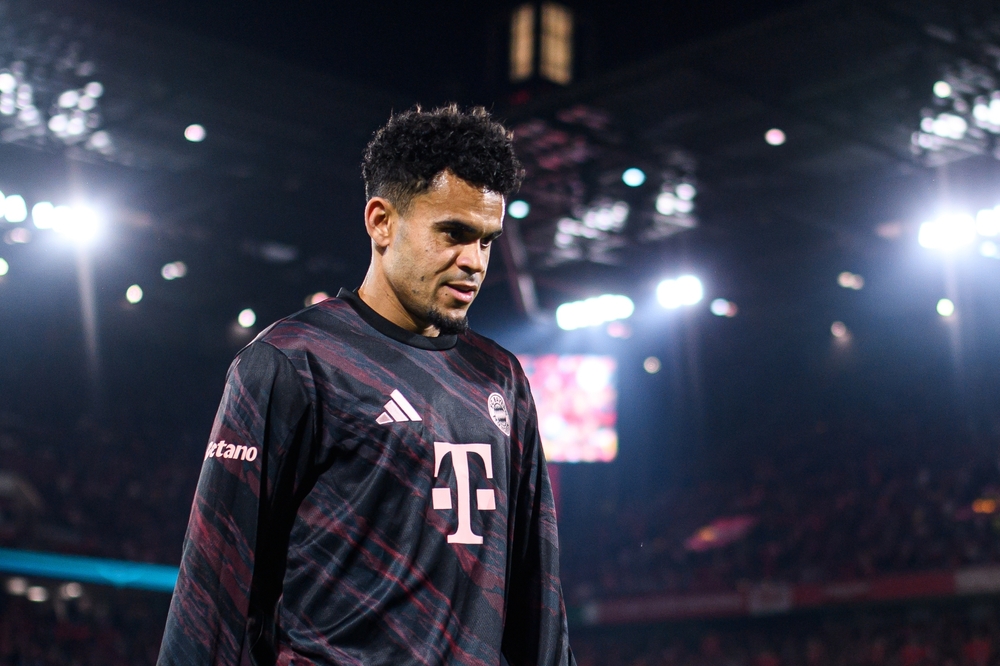
The 28-year-old former Liverpool winger joined Bayern Munich for a reported £65 million in July 2025 and has produced the finest season of his club career: 26 goals and 21 assists across all competitions, forming part of a front three alongside Harry Kane and Michael Olise that has driven Bayern’s domestic and European campaign. The first-generation Colombian from La Guajira, who grew up in conditions of profound hardship, Diaz brings an intensity to every match that goes beyond mere technical ability. His seven qualifying goals – second across the entire CONMEBOL campaign to Messi – confirm that his club output transfers directly to international football, and at 28, he is arriving at his first World Cup in the best form of his life. If Colombia go deep into this tournament, Diaz is why.
James Rodriguez – Midfielder, Minnesota United (Captain)
The 2014 Golden Boot winner, now 34, is simultaneously Colombia’s greatest creative asset and their greatest risk. His technique remains extraordinary – the touch, the vision, the dead-ball delivery, the ability to find space in crowded midfields – but his continuity has been the defining problem of a late career that has taken him through Real Madrid, Bayern Munich, Everton, Al-Rayyan, Olympiakos, São Paulo, Club León and now Minnesota United. He signed for the MLS club in February 2026 specifically to accumulate competitive minutes before the World Cup. The three-day hospitalisation in March following the France match was a serious alarm, and his fitness between now and the group opener will be monitored by every Colombian supporter and serious bettor. When James is sharp, Colombia are a quarter-finalist. When he is not, the creative hub is missing and the system struggles.
Daniel Muñoz – Right-back, Crystal Palace
The Crystal Palace full-back was an FA Cup winner in 2025 and has been one of the most consistently impressive performers in Premier League football across this cycle. His crossing quality and ability to arrive in the box as a secondary attacker – averaging close to three key passes per 90 minutes in league football – give Colombia’s right side a genuine attacking dimension that supplements Diaz’s creativity on the left. His one-on-one defensive reliability was tested by France in March but his attacking output across the season for Oliver Glasner’s Palace remains elite at full-back level.
Richard Rios – Midfielder, Benfica
The 24-year-old has developed rapidly since moving from Palmeiras to Benfica and is now recognised as one of the most complete box-to-box midfielders in Portuguese football. His ability to carry the ball from deep, win physical duels in midfield and arrive late to support attacking moves makes him the engine of Lorenzo’s double pivot alongside Lerma. Squawka’s tactical analysis described Rios as “the tactical fulcrum” – the player who allows James the freedom to roam and Diaz the licence to go one-versus-one. He is Colombia’s most important midfielder when James is absent, and their second most important when he is fit.
Davinson Sánchez – Centre-back, Galatasaray
Former Tottenham Hotspur defender Sánchez brings six seasons of Premier League experience and Champions League football to Colombia’s back line. Now at Galatasaray, where he has won the Turkish Süper Lig, the 28-year-old provides the aerial authority and pace that Lorenzo’s defensive structure requires against the physical strikers Colombia will face in the knockout rounds. His Spurs career produced exactly the kind of elite-level experience that the Colombia centre-back pairing needs alongside Bologna’s Lucumí.
Strengths & Weaknesses
Strengths
The Diaz-James axis is, when both men are fit and sharp, one of the most dangerous creative combinations at this tournament. Diaz’s physical attributes – pace, dribbling, finishing from both feet, aerial threat – provide a direct goal threat that no central defensive partnership can ignore on a one-on-one basis. James’s delivery from set pieces and his through-ball range from the number ten position creates second-order attacking opportunities that teams who overload to stop Diaz leave themselves exposed to. Together, the two represent a creativity-and-execution partnership that Colombia’s 2024 Copa América campaign – 28 games unbeaten, Copa América final – demonstrated is capable of defeating any opponent in a single match.
The Premier League influence is substantial and directly relevant. Three of Colombia’s first-choice outfield players – Muñoz, Lerma and Sánchez (ex-Spurs, now Galatasaray) – have competed in the Premier League and Champions League. Wolverhampton’s Mosquera provides additional top-flight coverage. Rios’s Benfica experience in the Champions League and Diaz’s Bundesliga and UCL campaigns with Bayern confirm that this squad’s collective European top-flight exposure is significantly deeper than the market’s 40/1 outright price implies. They are a physically and technically mature unit across every department except, potentially, in goal.
The Group K draw was kind. Uzbekistan – making their first-ever World Cup appearance – and DR Congo, who qualified via the inter-confederation play-offs in their first appearance since 1974, represent matches that Colombia must win to generate the platform for a points-or-better result against Portugal. The expanded 48-team format also means a best third-place finish is sufficient for progression, adding another safety net that reduces the existential pressure of the Portugal fixture.
Weaknesses
The goalkeeper position is the squad’s most glaring structural concern. Camilo Vargas at 37 does not represent a reliable last line against top-quality finishing, and both the Croatia and France March friendlies saw goals conceded from situations that any elite-level goalkeeper should have commanded. When the squad’s first and second choice goalkeepers are both in their late thirties and neither plays in Europe’s top five leagues, the concern is legitimate rather than speculative.
The set-piece vulnerability exposed by Croatia and France in March is the second pressing tactical concern. Multiple goals across both matches came from dead-ball situations – headers, corners, free kicks – that Lorenzo’s defensive organisation failed to prevent. Against Portugal and Bruno Fernandes’s delivery in particular, this is a structural problem that cannot be corrected by individual quality alone and requires tactical adjustment before the group stage.
James Rodriguez’s fitness is the third dimension of uncertainty, and the most consequential. The gap between Colombia with James on form and Colombia without him is, as the RotoWire Group K preview noted, the largest single variable in their tournament prospects. No other player in the squad provides the same creative catalyst from the number ten position, and without it, the system’s dependency on individual brilliance from Diaz becomes the primary – and more easily defended – attacking threat.
Qualifying Campaign
Colombia’s CONMEBOL campaign was the best the country had produced since 2014, when they qualified in second place. Under Lorenzo, they finished third in the 10-team round-robin with 28 points – the same total as fourth-placed Uruguay and sixth-placed Paraguay, with the three teams separated by goal difference and head-to-head results. Argentina topped the table with 38 points, Ecuador finished second with 29. The standout result was the victory over Brazil as part of the unbeaten run. Qualification was clinched with a match to spare via a 3-0 home win over Bolivia on 4 September 2025, with Diaz providing the assist for the third goal.
| Team | P | W | D | L | GF | GA | GD | Pts | Status |
| Argentina | 18 | 12 | 2 | 4 | 31 | 10 | +21 | 38 | Qualified |
| Ecuador | 18 | 9 | 2 | 7 | 27 | 21 | +6 | 29 | Qualified |
| Colombia | 18 | 7 | 7 | 4 | 28 | 18 | +10 | 28 | Qualified |
| Uruguay | 18 | 7 | 7 | 4 | 22 | 12 | +10 | 28 | Qualified |
| Brazil | 18 | 8 | 4 | 6 | 24 | 17 | +7 | 25 | Qualified |
| Paraguay | 18 | 7 | 7 | 4 | 14 | 10 | +4 | 28 | Qualified |
| Bolivia | 18 | 6 | 2 | 10 | 17 | 35 | -18 | 17 | Intercontinental play-off |
World Cup History: Tragedy, Brilliance and the 2014 Benchmark
Colombia’s World Cup history is written in extremes. The 1962 debut was unremarkable, but the 1990 return – featuring René Higuita’s scorpion-kick saves and Carlos Valderrama’s extraordinary passing – produced a round-of-sixteen appearance and captured global imagination. Then came 1994 and the darkest chapter in Colombian football: Andrés Escobar’s own goal in a group-stage defeat to the United States, followed by his murder in Medellín ten days after returning home. The tournament’s shadow fell across the entire nation.
The 1998 World Cup brought further group-stage elimination – 2-2 with Scotland, 1-0 to Romania, 3-1 to Morocco – without the redemptive arc the talent deserved. After failing to qualify for 2002, 2006 and 2010, Colombia returned in 2014 under José Pékerman for the tournament that defined the generation. James Rodriguez’s volley against Uruguay in the round of sixteen – a 25-yard left-foot strike that was voted FIFA Goal of the Tournament – announced a player and a campaign to the world. Colombia reached the quarter-finals for the first and only time in their history, ultimately losing 2-1 to Brazil after a controversy-laden match. James finished as the tournament’s top scorer with six goals, winning the Golden Boot at age 22.
The 2018 campaign produced a round-of-sixteen exit to England – beaten on penalties after a 1-1 draw in which Yerry Mina equalised in stoppage time – before Colombia failed to qualify for Qatar 2022 entirely, a disappointment that prompted wholesale tactical and managerial changes. The 2026 squad’s burning ambition is to return to – and surpass – the 2014 quarter-final standard, and the individual quality available to Lorenzo suggests that ambition is not unrealistic.
Group K & Fixtures: Three Different Opponents, One Clear Target
Colombia were drawn into Group K alongside Portugal, DR Congo and Uzbekistan – a group that gives Los Cafeteros a clear path to the knockout stage if they perform to their capacity. Uzbekistan, making their first-ever World Cup appearance, and DR Congo, returning for the first time since 1974 via the intercontinental play-offs, are both manageable opponents for a squad of Colombia’s quality. Portugal are the group’s dominant force, with Cristiano Ronaldo – who confirmed in February that this will be his final World Cup – Bruno Fernandes and a squad carrying one of the tournament’s most established pedigrees.
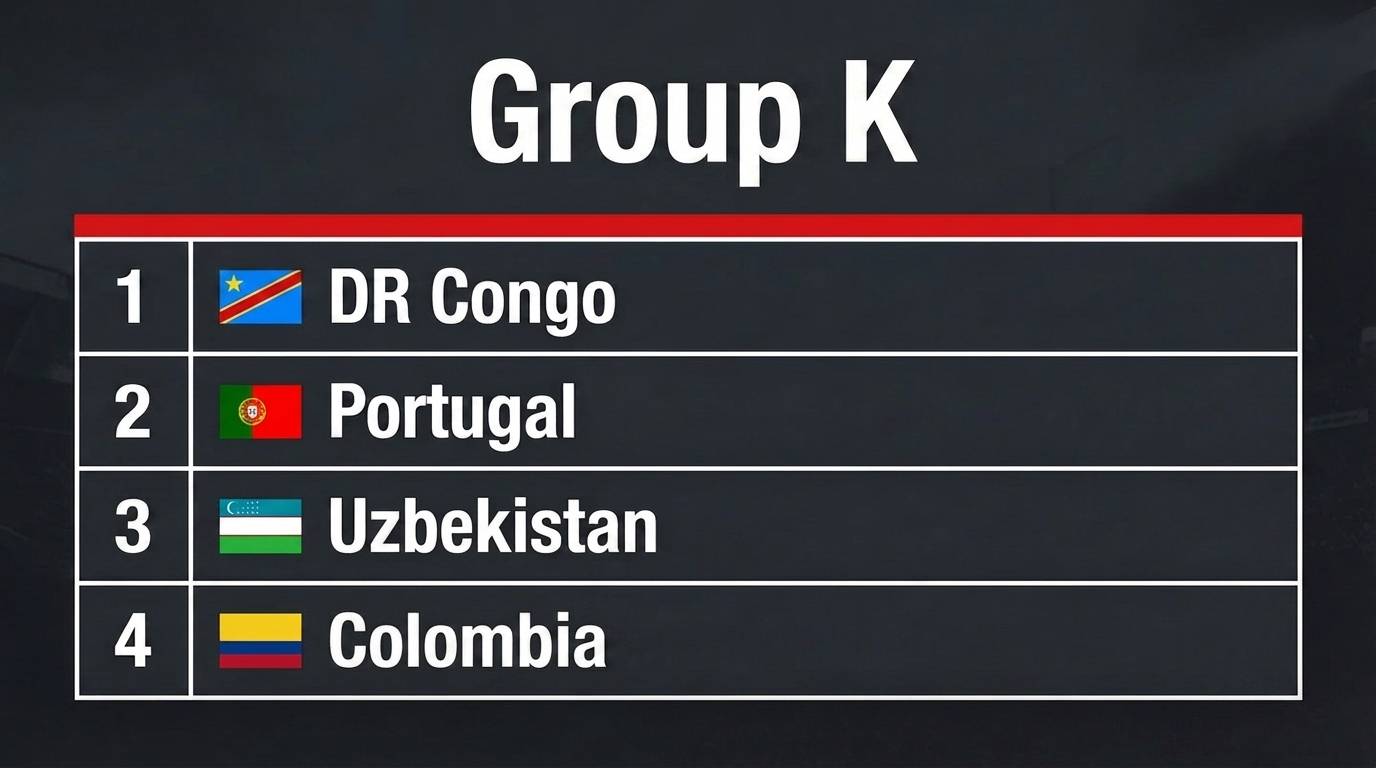
The group’s sequencing matters significantly. The opener against Uzbekistan at the Estadio Azteca in Mexico City on 18 June is a must-win fixture – three points and a clean sheet reset the narrative around the March defeats and establish momentum. DR Congo in Guadalajara on 24 June, featuring former Manchester United and Crystal Palace defender Axel Tuanzebe and the explosive Newcastle forward Yoane Wissa, represent a tougher proposition than the third-place intercontinental qualifier status implies. The group decider against Portugal in Miami on 28 June – with qualification almost certainly already secured by that point – will determine whether Colombia enter the knockout stage as group runners-up or as one of the best third-placed teams.
| Date (BST) | Match | Venue | Stage |
| 19 June, 03:00 | Uzbekistan vs Colombia | Estadio Azteca, Mexico City | Group K |
| 25 June, 03:00 | Colombia vs DR Congo | Estadio Akron, Zapopan (Guadalajara) | Group K |
| 29 June, 00:30 | Colombia vs Portugal | Hard Rock Stadium, Miami Gardens | Group K |
As group runners-up, Colombia would face the winner of Group F (Netherlands’ group) in the Round of 32. See our World Cup 2026 groups guide for the complete bracket.
Odds & Predictions: Colombia at 40/1 – The James Factor and the Value Question
Colombia are currently priced at around 40/1 to win the 2026 World Cup outright with the major UK bookmakers – placing them tenth or eleventh in the market, broadly equivalent to their 13th FIFA world ranking. The compare.bet analysis rates them as a genuine quarter-final candidate at a realistic ceiling, and our editorial assessment agrees with that framing: at 40/1, Colombia represent one of the cleaner tournament value propositions in the South American block, given their talent pool, favourable group draw and the specific attacking quality of Diaz at his current Bayern Munich form level.
The outright case rests almost entirely on Diaz delivering World Cup performances that match his Bundesliga season output. If the Bayern Munich winger scores four or five goals in a run to the quarter-finals – a realistic projection based on his 26-goal season and his seven qualifying goals – Colombia’s route through Uzbekistan, DR Congo and potentially a weaker Round of 32 opponent creates a very credible path to the last eight. The market at 40/1 provides implied probability of approximately 2.4%, which feels like an underestimate for a team that reached the Copa América final, qualified third in CONMEBOL and beaten world-class opposition in multiple competitive fixtures under Lorenzo.
The risks are real and quantifiable. James Rodriguez’s fitness is genuinely binary: he either arrives sharp and transforms the system, or he is limited and Colombia become a more predictable team built around Diaz alone. The goalkeeping situation is a structural weakness that elite opponents will target. And the March defeats to Croatia and France confirmed that the defensive organisation is not yet robust enough to contain a Portugal or a Brazil for 90 minutes. For bettors who believe James will be fit and Diaz will peak at the right moment, 40/1 is the outright position to hold. For those who doubt the fitness narrative, the group qualification market at around 1/4 is the cleaner, lower-risk play. For the latest Colombia odds across all markets, visit our World Cup 2026 odds hub.
Our prediction: Colombia to finish second in Group K behind Portugal, advance through the Round of 32, and exit at the Round of 16 against a top European side. The qualification-to-quarter-finals scenario is plausible if James is fit. The group-stage exit scenario is also plausible if he is not. That is Colombia at the 2026 World Cup: magnificent promise, permanent uncertainty – and a 40/1 price that respects both.
Colombia’s 2026 World Cup campaign distils an entire generation of talent – Diaz’s brilliance, James’s experience, the Premier League solidity of Muñoz and Lerma, the emerging quality of Rios – into a single summer that could define or merely extend Los Cafeteros’ complex relationship with the tournament that has produced both their greatest glory and their greatest tragedy. With a Colombian diaspora across North America creating an atmosphere that will feel closer to a home tournament than away, the stage is set for something memorable. Whether it is Diaz scoring a goal as good as James’s 2014 wonder strike remains the question that will absorb Colombian football through the summer.