

 Germany arrive at the 2026 FIFA World Cup in North America with unfinished business and, for the first time in a decade, a genuine belief that the squad is capable of going the distance. The four-time champions – winners in 1954, 1974, 1990 and 2014 – have endured a humbling few years at major tournaments, crashing out at the group stage in both the 2018 and 2022 World Cups and exiting to eventual champions Spain in the quarter-finals at Euro 2024 on home soil. The ghost of those failures has shaped everything Julian Nagelsmann has built since taking charge, and the squad he has assembled for this summer is the most technically gifted Germany have taken to a World Cup in at least a decade. The Jamal Musiala and Florian Wirtz attacking partnership is arguably the most exciting midfield duo at the entire tournament, the defensive structure is more coherent than it has been since the 2014 triumph, and the depth across positions gives Nagelsmann genuine flexibility for a long run. For those looking at the Germany World Cup 2026 outright markets, the question is not whether Die Mannschaft have the talent to win – they demonstrably do – but whether they have the tournament temperament to finally convert that talent into a fifth world title. Our full analysis, squad breakdown, qualifying data and predictions are below. For the complete tournament picture, visit our World Cup 2026 betting hub.
Germany’s Road to the World Cup
 Germany’s qualification story began with a stumble that set the tone for an entire campaign. Dropped into UEFA Group A alongside Slovakia, Northern Ireland and Luxembourg as a consequence of their Nations League quarter-final victory over Italy, Nagelsmann’s side lost their opening fixture 2-0 to Slovakia in Bratislava – a defeat that prompted sharp scrutiny of the squad and raised uncomfortable echoes of previous major tournament failures. The response, however, was emphatic.
After that September setback, Germany won their next five qualifying fixtures without conceding a single goal. The run included a 3-1 victory over Northern Ireland, a 4-0 demolition of Luxembourg, a 1-0 win in Belfast, and a remarkable 6-0 hammering of Slovakia in the group’s final match – a result that mathematically confirmed group victory and sent Slovakia to the play-offs. Germany finished top of Group A with 15 points from six matches: five wins, no draws, one defeat.
The caveat worth noting is the relative quality of the opposition. Slovakia, Northern Ireland and Luxembourg represent a weaker four-team group than Germany might expect against the established European powers, and Nagelsmann used the windows aggressively for tactical experimentation, particularly in rotating his attacking combinations to identify his best front four. Florian Wirtz – who created more chances than any other German player across the qualifying campaign with 20 in total – stamped his authority as the team’s primary creative force, and Nick Woltemade’s header in the final fixture against Slovakia reminded everyone that Germany’s attacking depth extends well beyond the headline names.
Manager & Tactics: Nagelsmann’s 4-2-3-1 and the Musiala Question
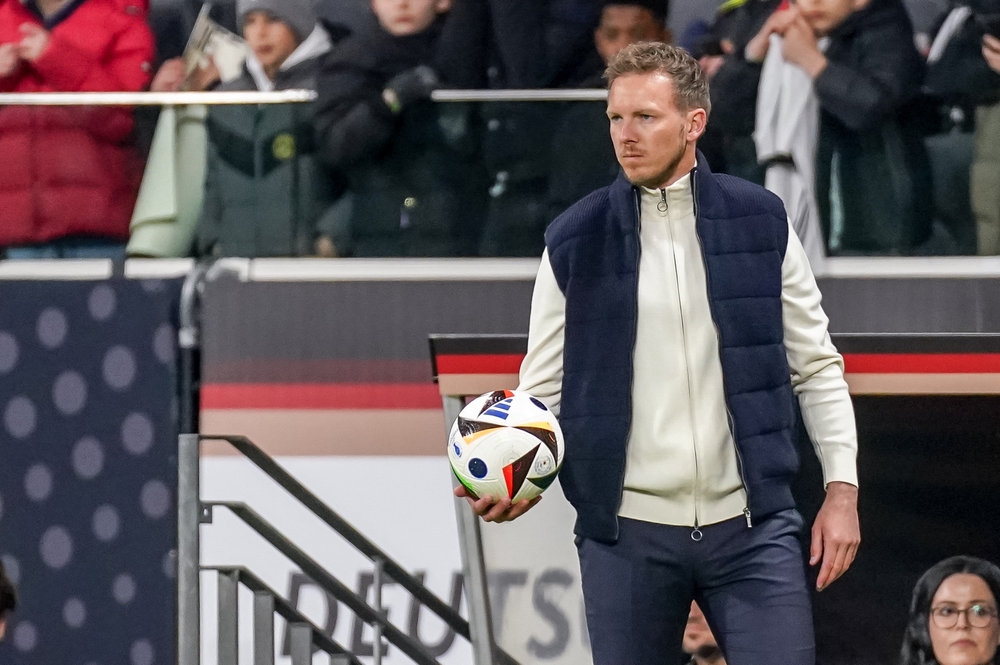
Julian Nagelsmann took charge of Germany in September 2023 following Hansi Flick’s dismissal, and the 38-year-old has transformed the tactical identity of Die Mannschaft with considerable speed. The team that exited in the group stages of consecutive World Cups was slow, predictable and defensively naive. The team Nagelsmann has constructed is vertically aggressive, pressing-oriented and tactically intelligent – and crucially, the Euro 2024 quarter-final defeat to Spain, decided in extra time at Stuttgart, was arguably Germany’s finest performance at a major tournament in eight years. The Deutscher Fussball-Bund rewarded that progress with a contract extension through the 2028 European Championship.
The preferred system is a 4-2-3-1 that can shift into a 4-3-3 or a back three depending on the opponent. Captain Joshua Kimmich operates at right-back under Nagelsmann for Germany – a position that sacrifices his creative potential from central midfield but provides defensive solidity and exceptional dead-ball delivery from wide positions. Jonathan Tah and Nico Schlotterbeck form the preferred centre-back partnership; Antonio Rüdiger’s Real Madrid injury record has complicated his involvement, while David Raum’s free-kick quality and tenacity give the left flank an attacking dimension.
The central tactical jewel is the Musiala-Wirtz combination behind the striker. When both are available and in form, Germany possess two players capable of simultaneously dismantling any defensive structure in the world: Musiala’s close-control dribbling and the ability to find pockets in tight spaces, Wirtz’s distribution, chance creation (1.03 big chances created per 90 in qualifying) and late arrivals from deep. The question hanging over the tournament is Musiala’s fitness – the Bayern Munich playmaker suffered a fractured fibula and dislocated ankle at last summer’s Club World Cup, returned briefly before re-aggravating the injury in March, and only returned to competitive action for Bayern in April, scoring in a 5-0 win over St Pauli. Nagelsmann has made clear Musiala must prove full fitness before the provisional squad announcement in mid-May. Without him, Wirtz carries an enormous creative burden alone; with him, Germany have a genuine case as the most technically dangerous side in the tournament.
Up front, Kai Havertz – the Arsenal striker – is the first-choice number nine when fit, combining aerial presence and pressing quality with the link-up play that Nagelsmann’s system demands. A knee injury interrupted his season before his return in March, but a further knock in late April casts fresh doubt over his availability. Nick Woltemade of Newcastle United provides capable cover, but the gap between the two in terms of technical quality at elite international level is real.
Squad & Key Players
Germany’s squad blends a generation-defining attacking core with experienced leaders and the best of the current Bundesliga talent pool. Manuel Neuer’s international retirement after Euro 2024 created a goalkeeping vacancy that Oliver Baumann has filled by default, with Marc-André ter Stegen’s persistent injury problems removing his candidacy from the conversation ahead of the tournament.
| Position | Player | Club | Age |
| GK | Oliver Baumann | Hoffenheim | 35 |
| GK | Alexander Nübel | Stuttgart | 29 |
| GK | Jonas Urbig | Bayern Munich | 24 |
| RB | Joshua Kimmich (c) | Bayern Munich | 31 |
| CB | Jonathan Tah | Bayern Munich | 29 |
| CB | Nico Schlotterbeck | Borussia Dortmund | 25 |
| CB | Antonio Rüdiger | Real Madrid | 33 |
| LB | David Raum | RB Leipzig | 26 |
| MF | Aleksandar Pavlović | Bayern Munich | 21 |
| MF | Florian Wirtz | Liverpool | 22 |
| MF | Jamal Musiala | Bayern Munich | 22 |
| MF | Leon Goretzka | Bayern Munich | 30 |
| MF | Pascal Groß | Borussia Dortmund | 34 |
| FW | Kai Havertz | Arsenal | 26 |
| FW | Nick Woltemade | Newcastle United | 23 |
| FW | Deniz Undav | Stuttgart | 28 |
| FW | Leroy Sané | Galatasaray | 30 |
| FW | Lennart Czyborra | Atalanta | 25 |
Jamal Musiala – Midfielder/Forward, Bayern Munich
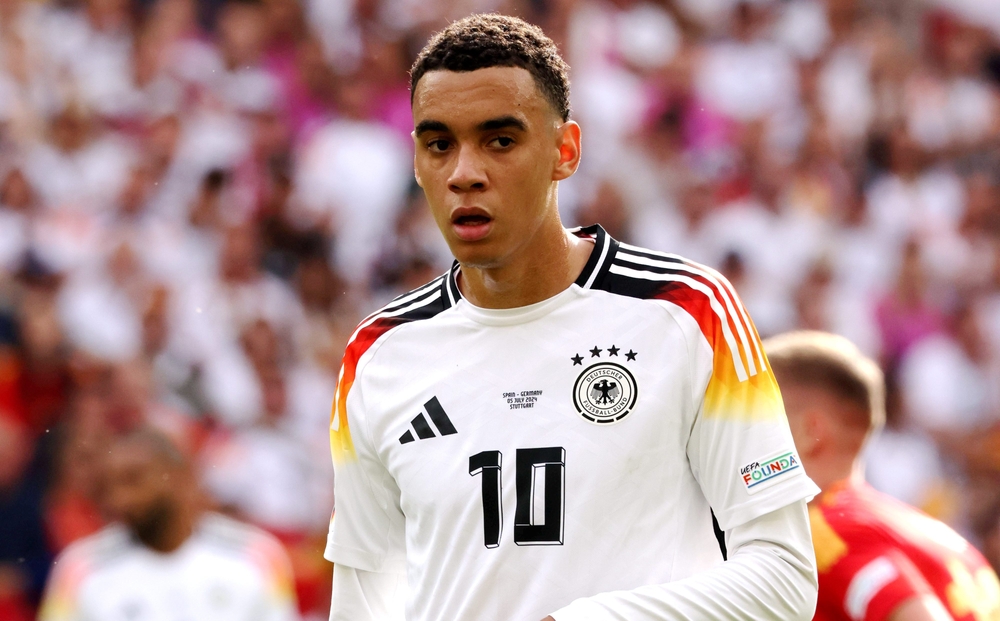
The 22-year-old born in Stuttgart and raised partly in England – he trained at Chelsea’s academy before choosing Germany – is widely regarded as one of the two or three most gifted players in European football. At full fitness, his close-control dribbling, spatial intelligence and ability to create from central positions are without parallel in this Germany squad. The caveat is that “at full fitness” has been a recurring qualifier throughout the 2025-26 season following his serious ankle injury. Bayern’s confirmed return in April, with a goal and assist against St Pauli, suggests he will be available for the tournament. If he is, Germany’s ceiling rises significantly.
Florian Wirtz – Midfielder, Liverpool
The Liverpool playmaker has endured scrutiny over his first season at Anfield, but his Germany performances remain consistently elite. His 20 chances created in qualifying – more than any other German player – and his seamless interplay with Musiala confirm that the international environment suits him more comfortably than the Premier League’s physicality has allowed so far. At 22 and with the World Cup as a stage to redefine his reputation in England, Wirtz arrives with enormous motivation. He can operate as an inverted winger, a ten or a false nine, giving Nagelsmann tactical options no other player in this squad provides.
Joshua Kimmich – Right-back/Midfielder, Bayern Munich (Captain)
The Bayern Munich captain is the heartbeat of Nagelsmann’s Germany – a player whose reading of the game, dead-ball delivery and vocal leadership provide the disciplined foundation on which the team’s attacking creativity is built. His dead-ball delivery from the right creates one of the tournament’s most dangerous set-piece platforms. At 31, Kimmich is at his physical peak and arrives with the Champions League experience of more than a decade at elite European club level.
Kai Havertz – Forward, Arsenal
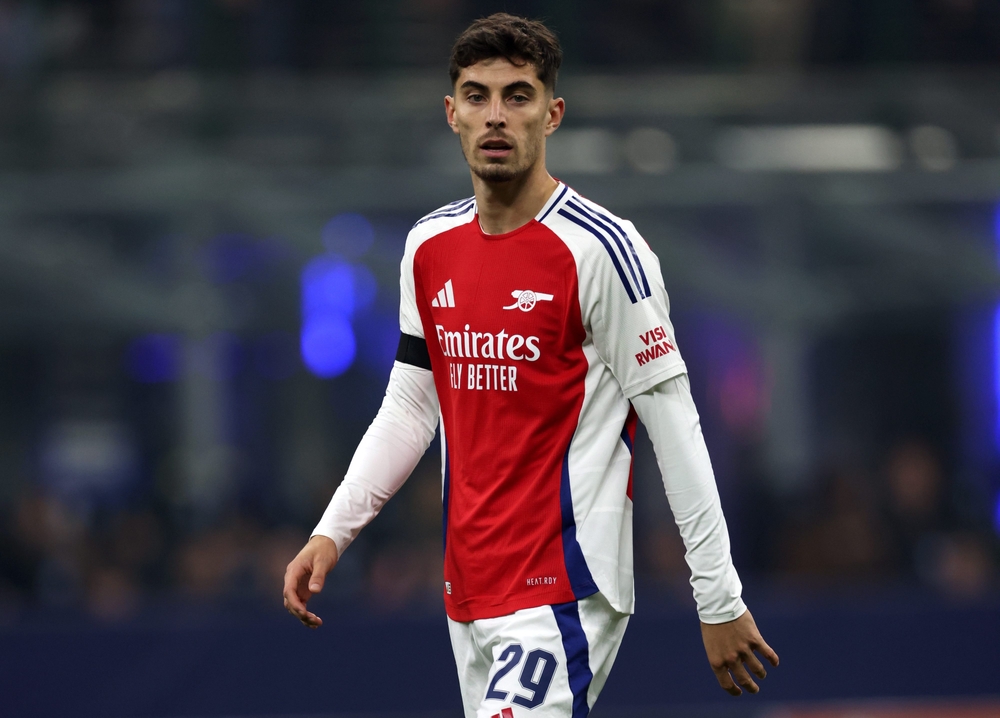
The Arsenal striker was Germany’s first-choice number nine when Nagelsmann returned to the role of centre-forward for Die Mannschaft, and his hold-up play, aerial threat and pressing quality complement the Musiala-Wirtz combination behind him. A knee injury cost him the first half of the season, and a further knock in late April 2026 raises fitness questions that Nagelsmann cannot ignore. Nick Woltemade, who headed in Germany’s opener in the 6-0 Slovakia rout, will deputise if required.
Aleksandar Pavlović – Midfielder, Bayern Munich
The 21-year-old has been one of the Bundesliga’s standout performers this season, establishing himself as Nagelsmann’s first choice in the holding midfield role through his Champions League campaign for Bayern. His ability to break up play, carry forward and cover the spaces left by the attacking midfielders gives Germany a defensive midfield anchor that the side has lacked since the peak-form era of Sami Khedira. He is the future of this Germany team’s engine room.
Strengths & Weaknesses
Strengths
The Musiala-Wirtz partnership, when both are fully fit, represents one of the most dangerous attacking midfield combinations at this tournament. Their ability to interchange positions, create from tight areas and produce decisive moments in the final third means Germany can unlock almost any defensive system at the highest level. Wirtz’s 20 qualifying chances created, combined with Musiala’s dribbling statistics from his pre-injury form – 2.4 successful dribbles per 90 in the Bundesliga – are objective evidence of the threat they pose together.
Depth in central midfield is another genuine strength. Beyond the Musiala-Wirtz-Pavlović combination, Nagelsmann can call upon Goretzka’s box-to-box energy, Groß’s composure and Kimmich’s versatility. In an expanded 48-team tournament where rotation across potentially eight matches is vital, this depth is a significant structural advantage compared to nations who rely on five or six players to carry the creative burden through a full campaign.
Germany’s set-piece delivery is also a weapon. Kimmich from the right, Wirtz and Raum from free-kick positions, and the aerial presence of Tah, Schlotterbeck, and a fit Havertz mean Nagelsmann can threaten from dead-ball situations in every match, including against elite defensive structures that might otherwise contain Germany from open play.
Weaknesses
Fitness uncertainty is the defining anxiety heading into the tournament. Musiala’s ankle, Havertz’s knee and ter Stegen’s absence from the goalkeeping picture are three significant injury concerns simultaneously, all involving players who would walk into most nations’ starting XIs. The worst-case scenario – Musiala unavailable, Havertz missing – leaves Nagelsmann’s attack considerably less threatening and asks questions about where Germany’s goals come from against organised knockout-stage opposition.
The goalkeeping position remains the squad’s most glaring structural weakness. Manuel Neuer’s retirement in 2024 removed one of the greatest goalkeepers in football history, and neither his anointed successor ter Stegen nor the backup options behind him inspire the same confidence in high-pressure moments. Oliver Baumann is reliable in Bundesliga terms but is 35 and has never been tested at this level. Should the tournament reach penalty shootouts, the goalkeeping quality that defined Germany’s previous World Cup triumphs is simply not present in this squad.
The Nations League semi-final performances – defeats to both Portugal and France in June 2025 – serve as a useful reminder that when Germany meet elite opposition, the gap in individual quality can still be exposed. France’s pressing and Portugal’s technical midfield both created sustained pressure that Nagelsmann’s defensive structure struggled to manage. Those patterns will concern the coaching staff more than any qualifying result.
Qualifying Campaign
Germany’s UEFA Group A qualifying campaign was bookended by a concerning defeat and a comprehensive triumph, with everything in between demonstrating the team’s growing consistency under Nagelsmann’s stewardship. The September opener against Slovakia produced a 2-0 loss – Germany’s only defeat in the entire campaign – before five consecutive victories returned the group to its expected order. The aggregate statistics confirm the squad’s attacking intent: 16 goals scored and just three conceded across six matches, giving a goal difference of +13 and a points return of 15 from a possible 18.
Wirtz’s contribution – two assists, 20 chances created in qualifying – was the campaign’s standout individual statistic. Kimmich’s double against Luxembourg in October underlined his set-piece value. And Woltemade’s opener in the 6-0 Slovakia rout served notice that Germany’s forward depth extends beyond the headline partnership of Havertz and the recovering Musiala.
| Team | P | W | D | L | GF | GA | GD | Pts | Status |
| Germany | 6 | 5 | 0 | 1 | 16 | 3 | +13 | 15 | Qualified |
| Slovakia | 6 | 3 | 0 | 3 | 9 | 11 | -2 | 9 | Play-offs |
| Northern Ireland | 6 | 2 | 0 | 4 | 5 | 11 | -6 | 6 | Play-offs* |
| Luxembourg | 6 | 1 | 0 | 5 | 4 | 9 | -5 | 3 | Eliminated |
World Cup History: Eight Finals, Four Titles, an Unmistakable Pedigree
Germany’s World Cup record is, by any objective measure, the most consistent in the history of the tournament. No nation has appeared in more World Cup finals – eight in total – and their four titles (1954, 1974, 1990, 2014) place them second only to Brazil’s five on the all-time winners list. They have reached at least the semi-finals in nine of the last fourteen tournaments, a run of sustained excellence unmatched by any other nation across the same period.
The 1954 “Miracle of Bern” – when a West German side defeated the technically superior Hungary 3-2 in the final in Switzerland – remains one of the defining upsets in tournament history. The 1974 triumph on home soil, defeating the Netherlands in a fiercely political final, established German football’s identity as a team that could absorb pressure and find solutions at critical moments. In 1990, a Rudi Völler-era side defeated Argentina 1-0 in Rome in what was the tournament’s least celebrated final but a piece of ruthless efficiency nonetheless. And the 2014 World Cup triumph in Brazil – most memorably the 7-1 semi-final demolition of the hosts – represented Germany’s return to the summit after 24 years, a victory underpinned by a generational recruitment strategy that had completely rebuilt the national side’s playing identity over two decades.
The group-stage exits in 2018 (Russia) and 2022 (Qatar) – each described in German football media as a “Schande” (scandal) – are the context for everything Nagelsmann has built since. This is a nation with a genuine weight of World Cup history and a squad that knows exactly what is expected of it.
Group E & Fixtures: The Redemption Mission Opens in Houston
Germany have been placed in Group E alongside Curaçao, Ivory Coast and Ecuador – a group that presents manageable opposition for a side of their quality, but one that carries a psychological dimension given their two recent group-stage exits. The irony is not lost on Nagelsmann or the squad: of all nations, Germany cannot afford to treat any group fixture as a formality. Curaçao, the smallest nation by population ever to qualify for a World Cup – approximately 156,000 people – provide the opening test in Houston on 14 June.
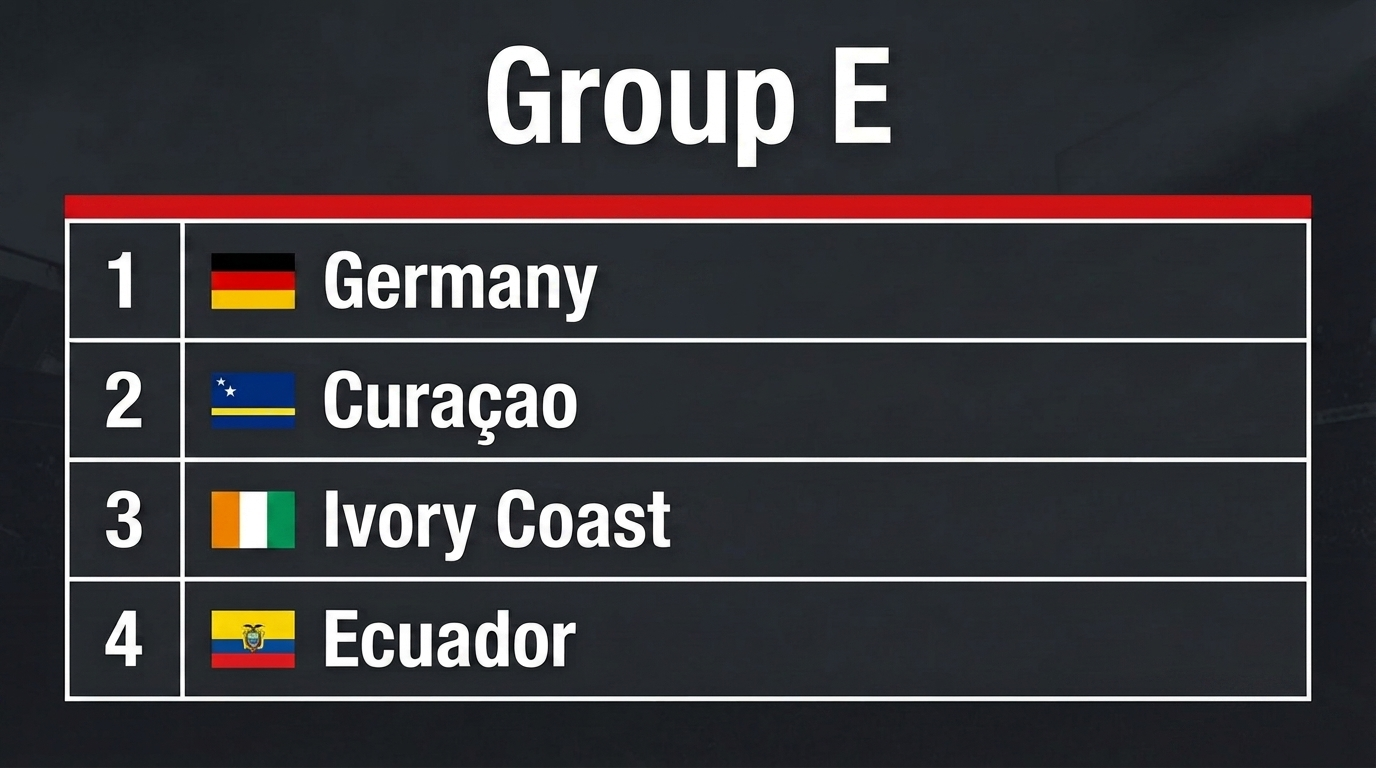
Ivory Coast return to the tournament for the first time since 2014, guided by Emerse Fae with Manchester United’s Amad Diallo and Franck Kessié among their most dangerous threats. Ecuador are the most credible obstacle to German progress, having finished second in CONMEBOL qualifying above Brazil, Colombia and Uruguay with an extraordinary defensive record of just five goals conceded in 18 matches. Their discipline and transitional efficiency make them a genuine test on the second matchday in Toronto.
| Date (BST) | Match | Venue | Stage |
| 14 June, 18:00 | Germany vs Curaçao | NRG Stadium, Houston | Group E |
| 20 June, 19:00 | Germany vs Ivory Coast | BMO Field, Toronto | Group E |
| 25 June, 19:00 | Germany vs Ecuador | MetLife Stadium, New Jersey | Group E |
All kick-off times BST (to be confirmed as tournament approaches). Germany are heavy favourites to top Group E. As group winners, they would face a third-placed team from another section in the Round of 32, with potential Round of 16 opponents from Group I (France, Norway) depending on final standings. See our full World Cup 2026 groups guide for the complete bracket.
Odds & Predictions: The Case for Germany at 14/1
Germany currently trade at around 14/1 to win the 2026 World Cup outright with the major UK bookmakers, placing them seventh in the market behind France and Spain (both ~5/1), England (~13/2), Brazil and Argentina (~8/1) and Portugal (~10/1). The implied probability at 14/1 is approximately 6.7%, and our editorial view is that this is arguably the most interesting value proposition on the entire outright board.
The case for Germany at 14/1 rests on three pillars: the quality of the squad when fully fit, the relative openness of their side of the draw, and the narrative momentum of a team with genuine redemption motivation. If Musiala and Havertz are both available and operating at full capacity, Germany possess the attacking combination to hurt any side in the world. Wirtz’s consistent international form – 20 qualifying chances created, two assists – confirms that the Liverpool playmaker remains world-class in a Germany shirt regardless of club form. And the Nagelsmann system, refined across three years and a Euro 2024 campaign that reached the last eight only through a contentious VAR decision, is tactically mature enough to adapt across eight matches.
The principal risk is fitness. If Musiala misses the tournament entirely, Germany’s ceiling drops sharply and the 14/1 looks significantly less attractive. The Nations League semi-final defeats to Portugal and France also demonstrated that against elite possession-based sides, Nagelsmann’s defensive shape can be overloaded – and any knockout path to the final will involve at least two such opponents.
Our prediction: Germany to reach the quarter-finals at minimum, with a realistic semi-final scenario if the bracket aligns. At 14/1, a small each-way position on outright glory – or a more focused Germany to reach the semi-finals market at around 5/1 – represents the cleaner value angle. For the full market range, compare the latest World Cup 2026 odds before placing any bet.
The 2026 World Cup represents Germany’s clearest opportunity in twelve years to reclaim the title that defines them. The talent is present, the system is coherent, and – critically – the collective memory of consecutive group-stage humiliations provides a motivational foundation that no other team at this tournament carries with the same intensity. Back them to go deep: the redemption story is compelling, and at 14/1, the price reflects doubt rather than quality.