

The World Cup 2026 format introduces the most significant structural change to the tournament since 1998. For the first time, 48 nations will compete in North America, across the United States, Canada and Mexico, in a format that replaces the familiar eight-group, 64-match model with 12 groups, a brand-new Round of 32 and 104 matches over 39 days. For supporters, bettors and football analysts alike, understanding the new 2026 World Cup format is essential: the route from group stage to the final is longer, the third-place qualification mechanism adds genuine tactical complexity, and the expanded bracket reshapes how odds are calculated across every stage. This guide breaks down every element of how the 48-team tournament works, from the group stage rules and tiebreakers through to the knockout bracket, squad regulations and the special rules that apply from the first whistle in Mexico City on 11 June to the final at MetLife Stadium on 19 July. For a full overview of the tournament, visit our World Cup 2026 hub.
Why FIFA Expanded: From 32 to 48 Teams
The decision to expand the World Cup from 32 to 48 teams was ratified by the FIFA Council in January 2017, though the final format, 12 groups of four, was only confirmed as recently as March 2023. Before that, FIFA had seriously considered using 16 groups of three teams, a structure that would have maintained the seven-match maximum for finalists but reduced group-stage games per team to just two. Critics rightly identified an increased collusion risk in three-team groups: with only one match separating progression from elimination, the final group game between two teams who knew exactly what result each needed represented an unacceptable integrity problem. FIFA eventually stepped back from that model and opted for the format fans know: groups of four, with the safety net of a best-third-place qualification mechanism to accommodate the extra 16 teams.
The commercial case for expansion is obvious, more teams means more nations with skin in the game, more broadcast markets engaged and more ticket revenue. But there is a genuine sporting argument too. The 1998 expansion from 24 to 32 teams brought in South Korea, who reached the semi-finals in 2002 as co-hosts, and Croatia, who finished third on debut in France that same year. The 2026 expansion to 48 brings in debutants Cape Verde, Curaçao, Jordan and Uzbekistan, as well as returnees such as DR Congo (absent since 1974) and Iraq (absent since 1986). The counterargument, that group-stage competition becomes diluted when the eight best third-placed teams qualify, has merit, but the 2022 edition demonstrated that even with 32 teams, weak groups can produce one-sided results. The real test will come in the knockout rounds, where the expanded bracket forces even the strongest sides to play an additional match before reaching the last 16.
From a betting perspective, the expansion matters in concrete ways. Outright tournament odds are compressed at the top, with more potentially weak opponents in early knockout rounds, the very best sides (Spain, France, England, Argentina, Brazil) are more likely to reach the quarter-finals without a major early-tournament upset. However, the additional Round of 32 fixture introduces one more moment where a tired or complacent elite side can come unstuck.
Group Stage: 12 Groups of Four, Points and Tiebreakers
The group stage structure will be familiar to any football fan. The 48 qualified nations are divided into 12 groups, labelled A through L, of four teams each. Every team plays the other three sides in their group once, producing six matches per group and 72 group-stage fixtures in total across 17 days (11–27 June). Three points are awarded for a win, one for a draw, zero for a defeat. The top two teams in each group advance automatically to the knockout rounds. For a full breakdown of which team is in which group, see our [World Cup 2026 groups guide].
What makes the 2026 group stage particularly interesting from a strategic standpoint is the tiebreaker hierarchy, which differs subtly from competitions such as the UEFA Champions League. Where UEFA prioritises head-to-head results, the FIFA World Cup uses overall group performance first, and understanding that distinction can have significant tactical implications by the time a group reaches its final matchday.
Group Stage Tiebreaker Order
| Step | Criterion |
| 1 | Points in all group matches (3 win / 1 draw / 0 loss) |
| 2 | Overall goal difference (goals scored minus goals conceded) |
| 3 | Overall goals scored |
| 4 | Head-to-head points between tied teams |
| 5 | Head-to-head goal difference between tied teams |
| 6 | Head-to-head goals scored between tied teams |
| 7 | Fair play record (disciplinary deductions) |
| 8 | FIFA World Ranking (most recently published) |
The fair play scoring system deducts points for yellow cards (–1), indirect red cards via a second booking (–3), direct red cards (–4) and yellow card followed by a direct red in the same match (–5). This tiebreaker has only ever been decisive once at a World Cup, Japan vs Senegal at Russia 2018, but in a tournament where the best third-placed teams must be compared across different groups, goal difference and goals scored take on additional significance. A team that wins comfortably but takes its foot off the accelerator in a meaningless third fixture could inadvertently assist a rival group’s third-placed team in the cross-group comparison.
One key implication for England: finishing top of Group L ensures a kinder Round of 32 draw. The bracket is pre-mapped, meaning the Group L winner faces a specific combination of runners-up and third-placed teams. Finishing second, by contrast, alters England’s bracket position and could produce a significantly more difficult path through the knockout stages.
The Eight Best Third-Placed Teams: Who Gets Through?
This is the element of the 2026 format that produces the most confusion, and the most interesting tactical chess in the final days of the group stage. Twelve groups produce 12 third-placed teams, but only eight of them advance to the Round of 32. Which eight? The ones with the best records across all groups, compared head-to-head using the same ranking criteria applied within individual groups: points first, then overall goal difference, then overall goals scored, then fair play record.
The critical implication is that a third-placed team’s results against all three opponents in their group count towards the cross-group comparison, not just their wins or draws. A side that finishes third with 4 points (a win and a draw) but a goal difference of +4 may well advance over a third-placed team from a different group with 4 points and +1 goal difference. This creates incentives to run up the score even in matches that appear already decided, a dynamic that produces more attacking, high-stakes football in the final group fixtures.
Historical context helps calibrate expectations. At the 1994 World Cup, the last to use a 24-team format with a best-third rule, the weakest qualifying third-placed team accumulated just three points with a goal difference of zero. In 2026, with 12 groups rather than six, the threshold for advancing is likely to be slightly lower in terms of absolute points (three points from one win may be sufficient in an expanded field), but goal difference will carry more weight as the ranking mechanism. For bettors, this dynamic means that in-play markets on final group-stage matches carry extra value: a comfortable win for one side can simultaneously eliminate a third-placed team watching anxiously from another group.
Forecasting which eight third-placed teams advance is essentially impossible before the groups begin, it depends on how every group plays out simultaneously. What is knowable is that the four weakest groups (in terms of overall quality) are most likely to produce third-placed teams who do not advance, because those groups are more likely to result in one dominant side winning all three matches and leaving the remaining teams fighting over a point each.
The Knockout Stage: Round of 32 to the Final
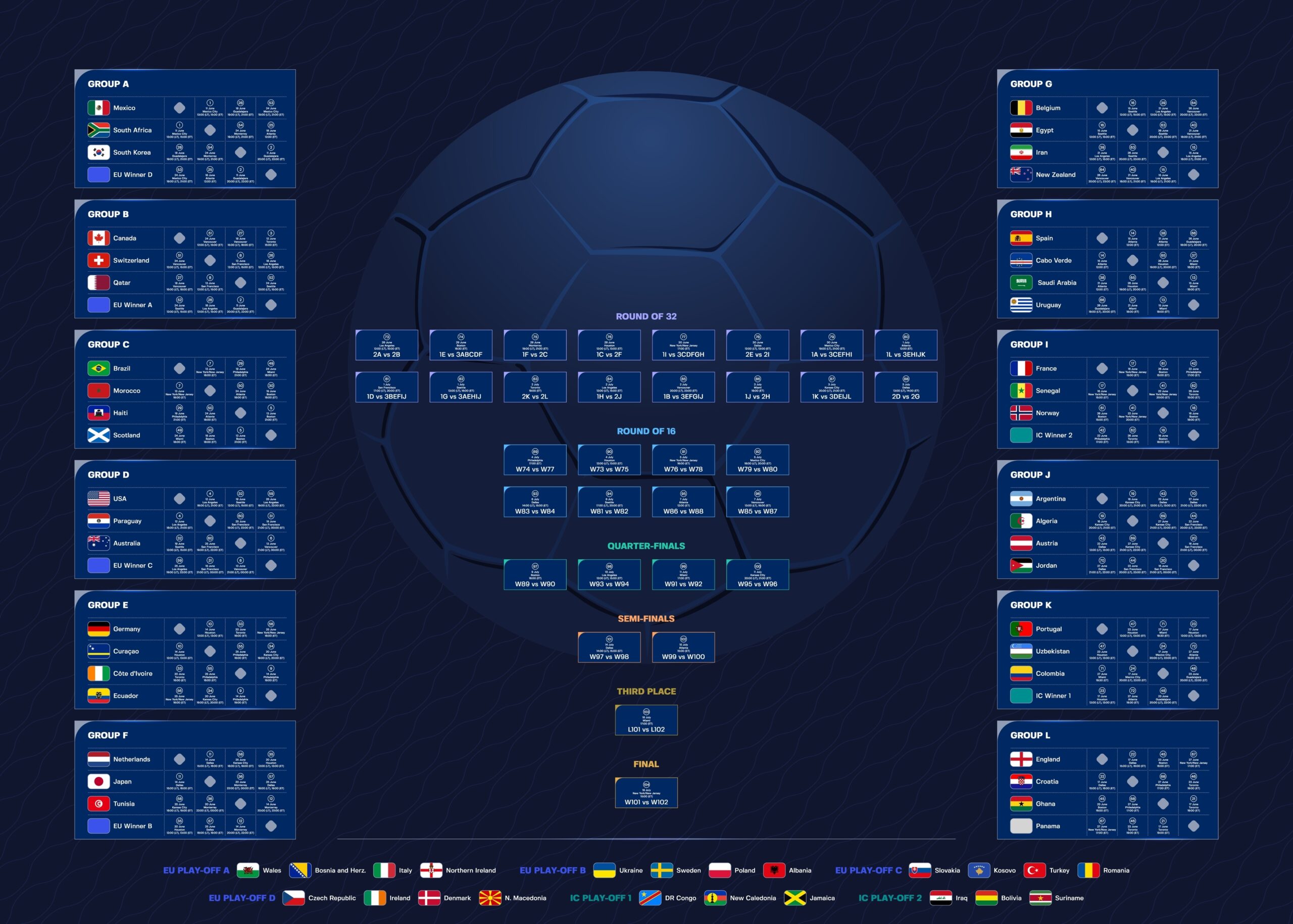
Once the group stage concludes on 27 June, 32 teams remain and the knockout rounds begin. This is where the 2026 format diverges most sharply from the tournament structure supporters have known since 1998. Instead of proceeding directly to a Round of 16, teams must first navigate a brand-new Round of 32, an extra match that has never previously existed at a men’s World Cup. Finalists will play eight matches in total, one more than at every previous edition of the tournament.
World Cup 2026 Knockout Stage Overview
| Round | Teams | Matches | Dates |
| Round of 32 | 32 | 16 | 28 Jun – 3 Jul |
| Round of 16 | 16 | 8 | 4–7 Jul |
| Quarter-finals | 8 | 4 | 9–11 Jul |
| Semi-finals | 4 | 2 | 14–15 Jul |
| Third-place play-off | 2 | 1 | 18 Jul |
| Final | 2 | 1 | 19 Jul |
The bracket for the Round of 32 is pre-seeded and pre-mapped. Group winners face opponents drawn from runners-up and third-placed qualifiers, with the specific pairings determined by which groups produce qualifying third-placed teams. Because those eight teams cannot be known until the group stage ends, FIFA pre-mapped all 495 possible combinations of third-placed qualifiers in advance of the tournament, meaning the bracket is fully determined the moment the final group-stage results come in, without any additional draw ceremony. This is a significant logistical improvement over previous systems that required last-minute reseeding.
The knockout stage from the Round of 32 onward is pure single-elimination. Any match still level after 90 minutes proceeds to 30 minutes of extra time (two 15-minute halves). If scores remain level after extra time, a five-round penalty shootout determines the winner; if the shootout remains tied after five rounds per side, it becomes sudden death. There are no away-goals rules or aggregate scores, every match is settled on the day.
FIFA has also structured the semi-final brackets to keep the tournament’s top four seeds apart until the last four. Spain and Argentina are on opposite sides of the draw, as are France and England, meaning that, assuming all four top seeds win their respective groups, they cannot meet before the semi-finals at the absolute earliest. If any of them slip up, however, that seeding protection disappears immediately.
Tournament Rules: Squads, Substitutions and Concussion Protocols
The operational rules for 2026 maintain the framework established at Qatar 2022, with a few refinements worth understanding before placing pre-tournament bets on squad depth and player availability.
Squad size: Each of the 48 nations names a final squad of between 23 and 26 players, of whom at least three must be goalkeepers. This is unchanged from the 2022 expansion (up from 23 players used at all tournaments between 2002 and 2018). With 12 bench seats available per match rather than 11, managers have genuine tactical flexibility in how they structure their substitution options across a potential eight-match campaign. England’s Thomas Tuchel, for example, has a deep Premier League talent pool to draw on, the expanded squad size allows him to carry specialist wide players, second-choice central midfielders and a back-up goalkeeper without sacrificing a seat that an outfield player might otherwise fill.
Substitutions: Five substitutions are permitted per team in normal time, across a maximum of three substitution windows (plus half-time). An additional sixth substitution is allowed if a match proceeds to extra time. Teams that use all five substitutions in normal time retain their extra-time sub; teams that have unused substitution windows in normal time can carry them into extra time. This rule rewards squad depth and gives managers who bring on three players at half-time the option of two further changes in the second half within two remaining windows.
Concussion substitutions: Introduced at Qatar 2022 and retained for 2026, a concussion substitute allows a team to replace a player suspected of having suffered a head injury without the replacement counting against the five-substitution allowance. Crucially, if one team uses a concussion substitute, the opposition receives an additional substitution in the same fixture to maintain competitive balance. This rule carries real betting significance in tight knockout matches, a concussion event effectively gives both teams an extra tactical card to play.
Injury replacements: Once a final 26-man squad is submitted, players can only be replaced in the event of serious injury or illness, subject to FIFA medical examination and approval within 24 hours of the nation’s first match. Goalkeepers are treated under slightly more flexible rules and can be replaced at any point during the tournament with medical evidence. For betting purposes, the period between squad announcement and each nation’s opening fixture is the window where injury news carries the most direct market impact. See our dedicated World Cup 2026 rules guide for a full breakdown of FIFA’s official regulations.
Why the New Format Matters for Betting and Viewing
The 2026 World Cup format changes the way the tournament should be approached from a wagering perspective. Eight matches to win the trophy (compared to seven previously) means that even the deepest, most balanced squads face genuine cumulative fatigue risk, particularly those from leagues with late domestic seasons who arrive with limited recovery time. Depth of squad, injury resilience and managerial rotation ability become more significant factors than they were in a seven-match tournament. The Round of 32 introduces a match that, for the top seeds, may appear routine on paper but carries all the psychological pressure of a first knockout game. Early exits at this stage, the equivalent of a Round of 16 departure in old money, will be devastating for major nations and will send outright odds markets into sharp movement. Follow our World Cup 2026 hub for pre-tournament analysis, group-by-group breakdowns and the latest odds from leading bookmakers as the tournament approaches.