

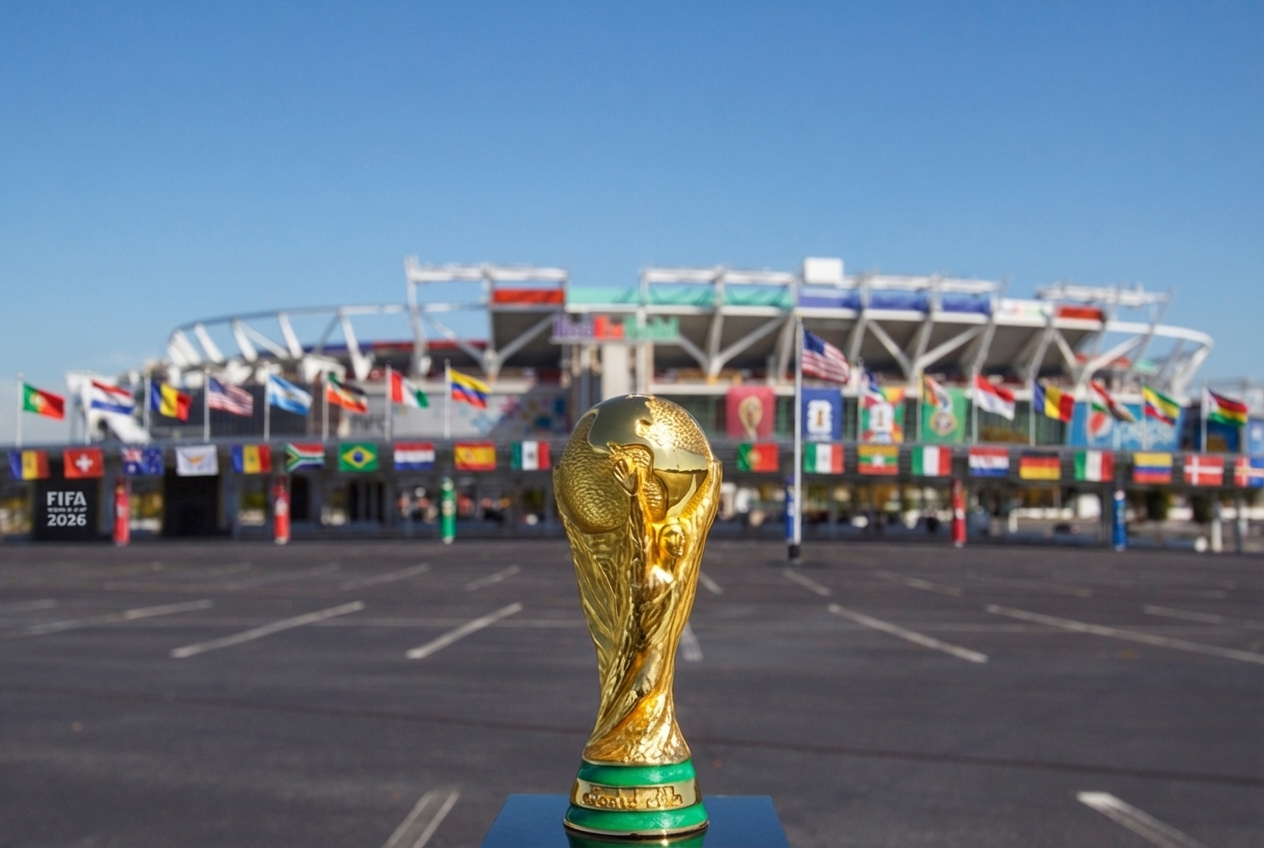
The FIFA World Cup is the most watched sporting event on the planet. Every four years, the world stops. Nations of a billion people pin their hopes on 11 men, and the tournament that began in Uruguay in 1930 with 13 teams has grown, in 2026, into a 48-nation spectacle spread across three countries and 39 days. Across 22 completed editions, only eight nations have ever won it. Billions have watched. Hundreds of players have become legends. A handful of moments have transcended sport entirely. This is the history of the World Cup: every champion, every record and the moments that define what the tournament means. For everything you need ahead of the 2026 edition in North America, visit our World Cup 2026 hub.
Nearly 100 Years of World Football’s Greatest Stage
Jules Rimet, the FIFA president whose name was later given to the original trophy, is the man who brought the World Cup into existence. The first tournament, held in Uruguay in 1930, was a modest affair, 13 nations, no qualification rounds, and a competition decided over 18 days in Montevideo. Uruguay, as hosts, lifted the first trophy. Argentina were beaten 4–2 in the final in front of 93,000 in the Estadio Centenario. Thirteen teams. Eighteen matches. The world barely noticed.
The tournament expanded rapidly. Italy hosted and won in 1934 and defended in 1938, becoming the first back-to-back champions. The tournament was suspended through the Second World War, no competitions in 1942 or 1946, and resumed in Brazil in 1950, when Uruguay produced one of the sport’s greatest shocks by beating the hosts in the decisive match before 199,954 people at the Maracanã. West Germany’s 3–2 defeat of Hungary in 1954, the “Miracle of Bern”, remains one of the defining underdog stories in tournament history. By 1966, when England lifted the Jules Rimet Trophy at Wembley, the World Cup had become the world’s defining sporting moment.
The tournament grew to 24 teams in 1982, then 32 in 1998, the last structural expansion until 2026’s leap to 48. In that time, South American and European nations have shared every trophy between them. No other confederation has ever reached a final, though Morocco came closer than any African nation when finishing fourth at Qatar 2022. The 2026 tournament represents the most significant expansion since France 1998, and, with Lionel Messi, Kylian Mbappé and Erling Haaland all in their primes , may deliver the richest collection of individual talent ever assembled at a single World Cup.
Every World Cup Winner: 1930 to 2022
| Year | Champion | Runners-Up | Score | Host |
| 1930 | Uruguay | Argentina | 4–2 | Uruguay |
| 1934 | Italy | Czechoslovakia | 2–1 (aet) | Italy |
| 1938 | Italy | Hungary | 4–2 | France |
| 1950 | Uruguay | Brazil | 2–1 (final group stage) | Brazil |
| 1954 | West Germany | Hungary | 3–2 | Switzerland |
| 1958 | Brazil | Sweden | 5–2 | Sweden |
| 1962 | Brazil | Czechoslovakia | 3–1 | Chile |
| 1966 | England | West Germany | 4–2 (aet) | England |
| 1970 | Brazil | Italy | 4–1 | Mexico |
| 1974 | West Germany | Netherlands | 2–1 | West Germany |
| 1978 | Argentina | Netherlands | 3–1 (aet) | Argentina |
| 1982 | Italy | West Germany | 3–1 | Spain |
| 1986 | Argentina | West Germany | 3–2 | Mexico |
| 1990 | West Germany | Argentina | 1–0 | Italy |
| 1994 | Brazil | Italy | 0–0 (aet; 3–2 pens) | USA |
| 1998 | France | Brazil | 3–0 | France |
| 2002 | Brazil | Germany | 2–0 | South Korea / Japan |
| 2006 | Italy | France | 1–1 (aet; 5–3 pens) | Germany |
| 2010 | Spain | Netherlands | 1–0 (aet) | South Africa |
| 2014 | Germany | Argentina | 1–0 (aet) | Brazil |
| 2018 | France | Croatia | 4–2 | Russia |
| 2022 | Argentina | France | 3–3 (aet; 4–2 pens) | Qatar |
Only eight nations have ever lifted the trophy in 22 editions. Brazil leads with five (1958, 1962, 1970, 1994, 2002), followed by Germany with four (1954, 1974, 1990, 2014) and Italy with four (1934, 1938, 1982, 2006). Argentina won their third in Qatar 2022, arriving in North America as defending champions for the first time since France did so in 2002.
The Most Successful Nations in World Cup History
Brazil: Five Stars, One Unforgettable Style
 No team defines the World Cup like Brazil. Five titles across six decades, 1958, 1962, 1970, 1994 and 2002, and the only nation to have played at every single edition of the tournament since 1930. The 1970 side under Mário Zagallo, featuring Pelé, Jairzinho, Rivelino and Tostão, is widely considered the finest team ever to play in a World Cup, winning all six games, scoring 19 goals and conceding just seven. Pelé scored 12 World Cup goals across three tournaments (1958, 1962, 1970), becoming the tournament’s youngest ever scorer at 17 years and 239 days against Wales in 1958 and later the youngest player to score in a final. Jairzinho achieved the unique distinction of scoring in every match during the 1970 tournament, six games, six goals. The 1994 and 2002 titles were built around a different set of Brazilian virtues, Ronaldo’s phenomenal goals ratio and the relentless forward threat of a nation that has not won the tournament since 2002 and has not been past the quarter-finals in six of the last seven editions. Carlo Ancelotti takes them to North America in 2026 as genuine contenders at 8/1 with leading UK bookmakers.
Germany: System Over Stars, Eight Finals
 Germany’s record of eight World Cup final appearances, more than any other nation, tells a story of relentless organisational excellence. West Germany lost the 1966 final to England at Wembley, won in 1974 on home soil with the Total Football generation, and came back in 1990 to beat Argentina 1–0 in Rome. Unified Germany then reached the 2002 final before finally winning again in 2014, becoming the first European team ever to win a World Cup on South American soil, courtesy of Mario Götze’s extra-time winner against Argentina in Rio. The 7–1 semi-final demolition of Brazil in that same tournament, delivered in front of a disbelieving Estádio Mineirão in Belo Horizonte, stands as one of the most shocking scorelines in World Cup history. Miroslav Klose scored his record-breaking 16th World Cup goal that night, surpassing Ronaldo’s previous record, fittingly in front of Ronaldo himself watching in the stands. Germany in 2026 under Julian Nagelsmann, with Florian Wirtz and Jamal Musiala in their prime, represent a potential dark horse at 14/1.
Italy: Four Trophies, Two Eras of Dominance
 Italy are the only team to win back-to-back World Cups, achieving the feat in 1934 and 1938 under the controversial patronage of Fascist-era Italian football. Their third title came in 1982, when a side that had drawn all three group games recovered to produce one of the tournament’s finest performances, beating Brazil 3–2 in a match many consider the greatest of all time, then defeating Argentina and Poland before defeating West Germany 3–1 in the final. Paolo Rossi scored six goals in three matches after returning from a two-year ban for match-fixing. Their fourth title in 2006 came via a penalty shootout against France, notable for Zinédine Zidane’s head-butt on Marco Materazzi in the final, perhaps the most sensational individual moment in a World Cup final since Geoff Hurst’s hat-trick in 1966. Italy, who failed to qualify for 2022 and 2026, will be notable by their absence in North America.
Argentina: Three Titles, Two Icons
 Argentina’s history at the World Cup is inseparable from two men: Diego Maradona and Lionel Messi. Maradona led Argentina to the 1978 title, though he was controversially left out of that squad as a teenager, before single-handedly conjuring the 1986 title in Mexico with the two greatest individual performances in a single tournament. Messi finally delivered Argentina their third World Cup in Qatar 2022, captaining the Albiceleste to a 4–2 penalty shootout victory over France in the greatest final ever staged, three goals in normal time, a Mbappé hat-trick tearing the lead away before Gonzalo Montiel’s penalty confirmed it. Argentina arrive in 2026 at 8/1 as defending champions, with a 38-year-old Messi in what will almost certainly be his final tournament.
🏴 England at the World Cup: One Glorious Summer, 60 Years of Waiting
England did not enter the first three World Cups, the FA had resigned from FIFA in 1928 over a dispute regarding payments to amateur players and did not rejoin until 1946. Their entry into the 1950 tournament in Brazil was expected to be a statement of the world’s greatest football nation reasserting authority over the international game. Instead, England lost to the United States 1–0 in one of the competition’s greatest upsets and were eliminated in the group stage. Four years later, in Switzerland in 1954, they reached the quarter-finals before falling to the eventual runners-up, Uruguay.
Then came 1966, and everything changed. Alf Ramsey’s side, built on defensive solidity and the energy of Bobby Charlton, Martin Peters and Geoff Hurst, negotiated all their matches at Wembley without conceding until the semi-final against Portugal. In the final on 30 July 1966, England led West Germany 2–1 with 12 minutes to play when a Wolfgang Weber equaliser sent the match to extra time. Geoff Hurst scored in the 98th minute, a shot that bounced off the underbar, and which Soviet linesman Tofiq Bahramov deemed to have crossed the line, a decision still contested by German historians and modern scientific analysis, then completed his hat-trick in the 120th minute. England won 4–2. Bobby Moore lifted the Jules Rimet Trophy. The most watched event in British television history up to that point. The only major tournament England have ever won.
What followed was a quarter-century of near-misses and occasional despair. The 1970 defence in Mexico ended in a quarter-final defeat to West Germany, England led 2–0, then lost 3–2 after extra time. They failed to qualify in 1974 and 1978, and in 1986 Diego Maradona scored both the “Hand of God” and the “Goal of the Century” in the quarter-final in Mexico City to eliminate them again. Bobby Robson’s 1990 side reached the semi-finals in Italy, where England lost to West Germany on penalties, Stuart Pearce and Chris Waddle the villains, before Graham Taylor’s team failed to qualify for 1994.
The modern era began slowly. Gareth Southgate’s 2018 squad in Russia, built around Harry Kane’s Golden Boot-winning seven goals, reached the semi-finals for the first time since 1990 before losing 2–1 to Croatia after extra time. In Qatar 2022, England were impressive in a 6–2 group-stage demolition of Iran and a clinical 3–0 dismissal of Senegal before losing a quarter-final to France 2–1, a match in which Harry Kane’s second penalty miss was the decisive moment. England’s World Cup record at tournament level: 1 title, 2 semi-finals (1990, 2018), 7 quarter-final exits, 3 failed qualifications (1974, 1978, 1994). For a detailed look at England’s complete history at the tournament, see our [England World Cup history guide](/world-cup-2026-england/).
World Cup Records That Stand the Test of Time
| Record | Detail | Year |
| All-time top scorer | Miroslav Klose (Germany) – 16 goals | 2002–2014 |
| Most goals in single tournament | Just Fontaine (France) – 13 goals in 6 matches | 1958 |
| Most titles | Brazil – 5 (1958, 1962, 1970, 1994, 2002) | – |
| Most final appearances | Germany / West Germany – 8 finals | – |
| Only team at every edition | Brazil – all 22 completed tournaments | 1930–2022 |
| Only player to score hat-trick in a final | Geoff Hurst (England, 1966); Kylian Mbappé (France, 2022) | 1966, 2022 |
| Youngest scorer | Pelé (Brazil) – 17 years, 239 days v Wales | 1958 |
| Biggest victory | Hungary 10–1 El Salvador | 1982 |
| Most goals in a single match (modern era) | Germany 7–1 Brazil (semi-final) | 2014 |
| Back-to-back winners | Italy (1934, 1938); Brazil (1958, 1962) | – |
| Golden Boot, England player | Gary Lineker (1986, 6 goals); Harry Kane (2018, 6 goals) | 1986, 2018 |
| Most expensive transfer player at tournament | Kylian Mbappé – Golden Boot 2022 (8 goals); Golden Boot 2018 (4 goals) | 2018, 2022 |
Legendary Moments That Defined the World Cup
Pelé’s First Final: 5–2 v Sweden, 1958
A 17-year-old from Bauru, São Paulo, walked onto the pitch at the Råsunda Stadium in Solna on 29 June 1958, and football would never look the same again. Brazil’s 5–2 victory over Sweden in the final is best remembered for two Pelé goals, a chest control and volley for the fourth, a header for the fifth, delivered with a technical assurance that made the world realise it was watching something that had not existed before. Pelé wept at the final whistle, too young to fully understand what he had just achieved, too gifted for anyone watching to look away. He would go on to win three World Cups. Brazil have chased that 1970 performance ever since.
The Hand of God and the Goal of the Century, Mexico 1986
England vs Argentina, 22 June 1986, Estadio Azteca, Mexico City. Within four minutes, the match produced the most controversial goal in history and then, arguably, the greatest. Maradona punched the ball into the net with his left hand, “a little with the head of Maradona and a little with the hand of God,” he said, with a smirk that infuriated a nation still processing the Falklands War of four years earlier. Then, five minutes later, he received the ball in his own half, turned and ran 60 metres, shielding the ball from Peter Reid, then Peter Beardsley, then Terry Butcher, then Terry Fenwick, before rounding goalkeeper Peter Shilton, who dived the wrong way both on the hand-ball and the dribble, and rolling it into an empty net. Fifty-six touches, 10.6 seconds, five outfield players beaten. FIFA later voted it the Goal of the Century. England manager Bobby Robson was too shattered to argue.
West Germany 3–2 Hungary: The Miracle of Bern, 1954
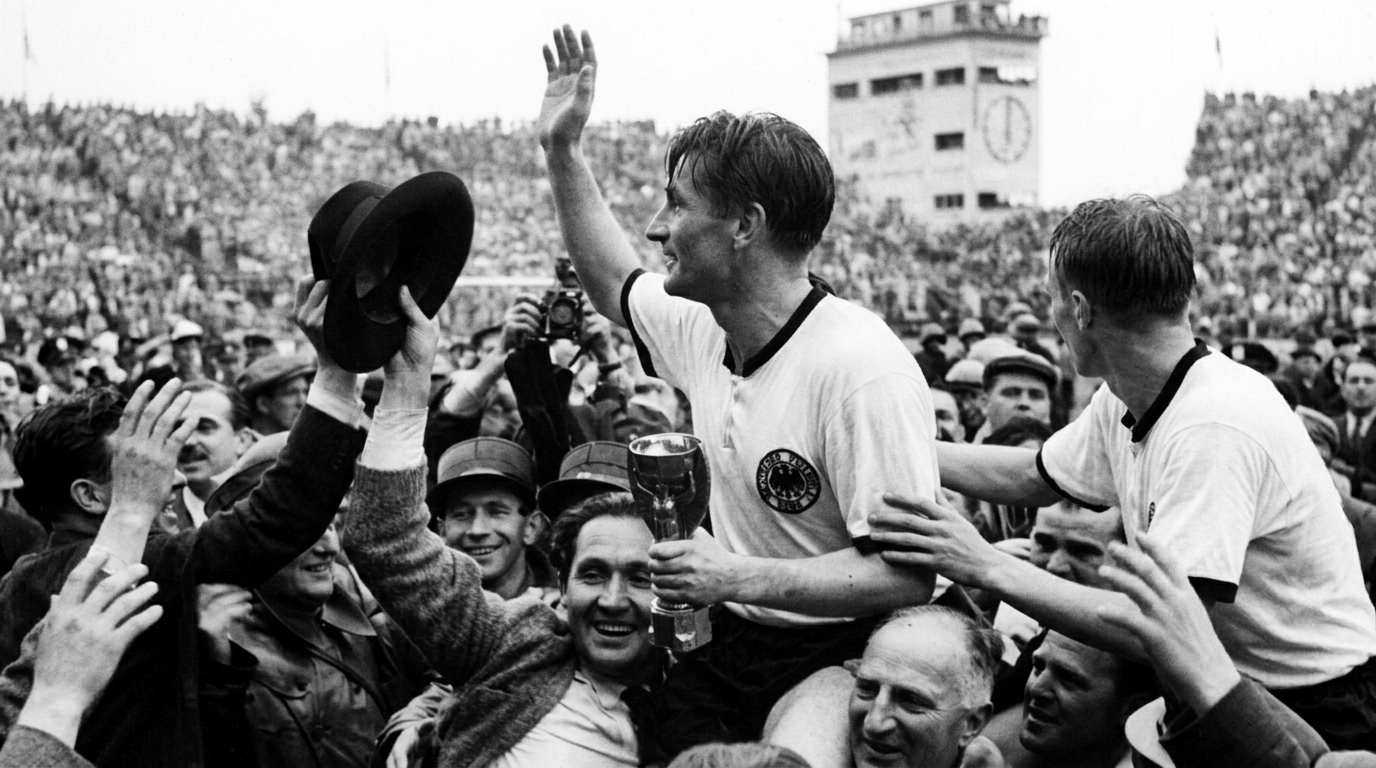
Hungary arrived in Switzerland in 1954 as the greatest team on earth. The “Mighty Magyars” had gone 32 games unbeaten, including an 8–3 demolition of West Germany in the group stage four days before the final. Ferenc Puskás, Sándor Kocsis and Nándor Hidegkuti had redefined how attacking football was played. The final at the Wankdorf Stadium in Bern was played in pouring rain. Hungary scored twice in the first eight minutes. West Germany equalised. Then Helmut Rahn scored twice in the second half to give the West Germans a 3–2 lead they held until the final whistle, a result so unexpected that commentator Herbert Zimmermann’s cry of “Aus! Aus! Aus! Das Spiel ist aus!” became the most recognisable phrase in German sporting history. Hungary’s golden generation never recovered. The 1954 final remains the definitive underdog story in tournament football.
Germany 7–1 Brazil, 2014
Host nation Brazil, shorn of their suspended captain Thiago Silva and injured Neymar, faced Germany in the semi-final at the Estádio Mineirão on 8 July 2014. What followed was not a football match, it was a sporting catastrophe broadcast live to 200 million Brazilian television viewers. Germany scored five goals in 18 minutes of the first half, Thomas Müller scoring a hat-trick, Miroslav Klose breaking his all-time World Cup goals record with the second of Germany’s seven. The result, 7–1, is statistically the largest defeat suffered by a host nation in World Cup history and remains the most shocking single scoreline in the modern game. Brazil’s squad wept on the pitch at the final whistle. The stadium wept in the stands. German journalists struggled to write about it without a trace of sympathy for a nation in genuine anguish.
Argentina 3–3 France (Argentina win 4–2 on penalties), Qatar 2022
The greatest World Cup final ever staged. Argentina led 2–0 with 10 minutes remaining. Mbappé scored twice in 97 seconds to level it. Messi scored in extra time. Mbappé completed his hat-trick with a penalty to make it 3–3. In the shootout, Emiliano Martínez saved from Kingsley Coman and Aurelien Tchouameni missed, leaving Gonzalo Montiel to score the decisive penalty. Messi, 35 years old, finally lifted the trophy he had spent 18 years pursuing. Mbappé, 23 years old, became the first player since Geoff Hurst in 1966 to score a hat-trick in a World Cup final. The match had everything, tactical shifts, individual brilliance, penalty-area drama, and the most emotionally loaded ending in the tournament’s modern era.
The World Cup in 2026: A New Chapter Begins
When Mexico and South Africa kick off the 48th World Cup on 11 June 2026 at Estadio Azteca, the first stadium to host matches at three separate World Cups, the tournament enters genuinely new territory. Messi at 38 pursuing an unprecedented second title. Mbappé at 27 chasing Klose’s all-time goals record. Haaland at 25 playing his first World Cup. Harry Kane at 32 leading England in what may be the Three Lions’ best chance of ending a 60-year wait. The records of the past set the stage for the records of the future, and at a 48-team tournament with 104 matches, 2026 may produce more of both than any edition before it. Everything you need for the 2026 World Cup is in our World Cup 2026 hub.