

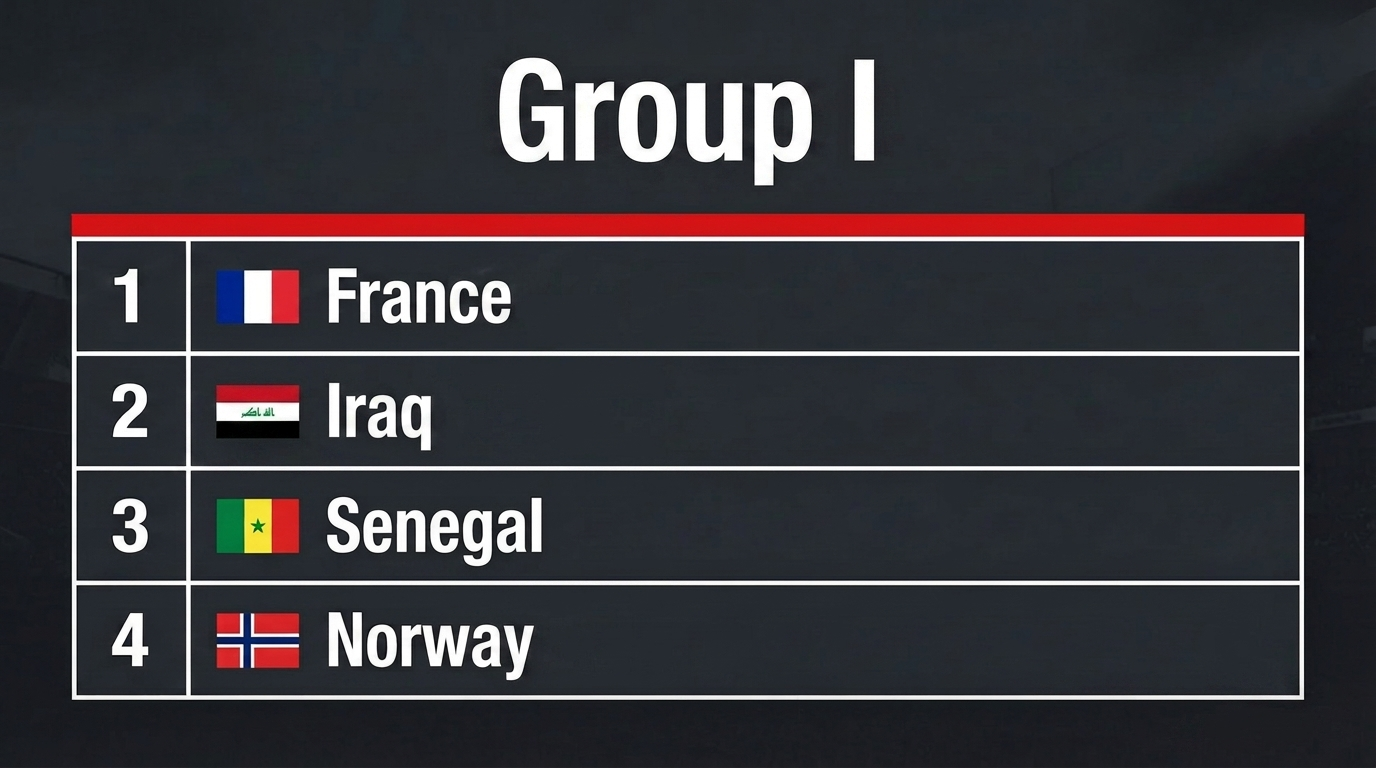
 Group I at the 2026 FIFA World Cup is the one most neutral observers would mark first in their programme. Four nations whose stories, quality and contrasting circumstances make it the genuine standout pool of the expanded 48-team tournament: France, two-time world champions and finalists in 2022; Norway, returning to the World Cup for the first time since 1998 carrying arguably the most dangerous striker on the planet; Senegal, the reigning AFCON title-holders with Premier League talent across the pitch; and Iraq, making their first World Cup appearance since 1986 after a qualification odyssey that unfolded against the backdrop of conflict and logistical nightmare. Group I has been called the “Group of Dveath” by commentators – manager Graham Arnold famously rebranded it the “Group of Excitement.”
France are clear favourites, but there is genuinely no obvious bottom-two in this pool. Norway’s firepower, Senegal’s tournament experience and Iraq’s Haaland-facing debut all make for a richly compelling ten days. For the full tournament picture, explore our World Cup 2026 hub, see how Group I compares across all twelve pools on our World Cup 2026 groups guide, and track the latest prices on our dedicated World Cup 2026 odds page.
France: Mbappe’s Last Chance to Win a Trio, Deschamps’ Final Chapter
 The pressure on France heading into 2026 is vast and layered. Manager Didier Deschamps – one of only three men to win the World Cup as both player and captain (1998) and as a manager (2018), a statistic that sets him in extraordinarily rare company – has confirmed this will be his final tournament in charge of Les Bleus. His squad, rebuilt around new stars yet anchored by old favourites, is the most talent-dense in international football by many assessments. A second title for Deschamps would be the capstone of the most distinguished managerial career in French football history.
The squad France have assembled is, in terms of raw quality, extraordinary. Kylian Mbappé (Real Madrid) enters as the defining figure, carrying the weight of an entire football nation’s ambition. He needs five goals to surpass Miroslav Klose’s all-time World Cup goals record of 16, having already scored a hat-trick in the 2022 final – the second player ever to do so, after England’s Geoff Hurst in 1966. His recent injury issues are the only caveat: a knee problem limited his involvement in March, but he returned to the squad for the warm-up fixtures against Brazil and Colombia, which France won convincingly. Ousmane Dembélé (PSG, 2025 Ballon d’Or winner) provides the right-wing danger to complement Mbappé, with Michael Olise (Bayern Munich) adding a dynamic third option in the final third. In attack there are further options: Hugo Ekitike and the PSG prodigies Désiré Doué and Bradley Barcola represent a generational depth few nations can match.
Defensively, France are equally formidable. William Saliba (Arsenal) and Dayot Upamecano (Bayern Munich) are the likely centre-back partnership, both Premier League and Bundesliga tested. Théo Hernandez (AC Milan) brings pace and attacking quality from the left. In midfield, Aurélien Tchouaméni (Real Madrid) and Adrien Rabiot anchor the double pivot. The return of N’Golo Kanté (Fenerbahçe) for one final major tournament adds a touch of old magic. Mike Maignan (AC Milan) is the goalkeeping first choice. France won both March friendlies – against Brazil and Colombia in the United States – playing with authority and the kind of collective composure that signals a team peaking at the right moment.
The France vs Senegal opener at MetLife Stadium in New Jersey on 16 June carries unmistakable echoes of 2002, when Senegal beat France in the group stage in one of the tournament’s most celebrated upsets. That context will not be lost on either squad.
Norway: 28 Years in the Wilderness, Haaland and Odegaard Ready to Deliver
 Norway’s return to the World Cup – their first since 1998, when they beat Brazil in the group stage before losing to Italy – is the result of the most dominant European qualifying campaign in this entire cycle. Manager Ståle Solbakken, who played six games for Wimbledon in the 1997-98 Premier League season and who has led Copenhagen to multiple Danish titles, has assembled the finest generation of Norwegian footballers since the late 1990s. Under his guidance they won their UEFA qualifying group by six points – topping it with 37 goals scored and just five conceded across eight matches, including a stunning 4-1 victory away at the San Siro to clinch qualification on the final matchday against Italy.
Erling Haaland (Manchester City) is, quite simply, the most talked-about striker at the 2026 World Cup. He scored 16 goals in eight qualifying matches – a rate of two per game that defies comprehension. The Golden Boot market has him as a frontrunner alongside Mbappé, and there is a genuine argument that if Norway progress from Group I and Haaland hits form, no goalkeeper in the tournament can be confident of keeping him quiet. However, a note of caution is warranted: as of late March 2026, Haaland had scored only three goals from open play in his last 19 club appearances, with his xG conversion rate dipping below his elite career average. He was absent from Norway’s March friendly against the Netherlands, reportedly for rest. Both he and Martin Odegaard (Arsenal, captain) are expected to be full fit and sharp by June – but both missed March camp through varying injury concerns, and Solbakken will have to manage their workloads carefully across three group matches.
Odegaard’s creative quality from an advanced midfield position is what makes Norway far more than a one-man team. When the Arsenal midfielder is operating at his peak – dictating tempo, finding pockets of space and threading passes behind the press – Norway have a genuinely elegant attacking identity beyond just “give it to Haaland.” Alexander Sørloth (Atletico Madrid) with 26 international goals, Sander Berge (Fulham, formerly Sheffield United) and Oscar Bobb (Fulham, on loan from Manchester City) round out a Premier League-stacked squad with genuine European club pedigree. Jørgen Strand Larsen (Crystal Palace) and Antonio Nusa (RB Leipzig) add further attacking options.
The Iraq game on 16 June is Norway’s clearest opportunity for three points, while the Senegal fixture on 22/23 June will most likely determine who finishes second. The group finale against France on 26 June is – if results fall right – potentially the most watched match of the group stage for Norwegian football in over a generation.
Senegal: The Lions of Teranga with Mané, Jackson and a Point to Prove
 Senegal arrive at the 2026 World Cup as the reigning champions of Africa – at least, in a manner that requires qualification. Their January 2026 AFCON final against Morocco ended in a 1-0 defeat on the pitch but was subsequently awarded to Senegal by the Confederation of African Football after Morocco’s players walked off to protest a penalty decision. Manager Pape Thiaw, in charge since December 2024 and with a record of ten wins and two draws from 13 games in charge, was banned for five games following the controversy. That turbulent ending to AFCON will provide the backdrop to their World Cup preparations.
The core of this squad is outstanding. Sadio Mané (Al-Nassr), 33, is the totemic figure: Senegal’s all-time leading scorer with 53 international goals, a former Liverpool and Bayern Munich star, Premier League champion, Champions League winner and AFCON title-holder. This is almost certainly his final World Cup and he arrives with the authority and experience to galvanise those around him. He scored five goals in World Cup qualifying and will be central to everything Thiaw’s side attempt in North America. Alongside him, Nicolas Jackson (Bayern Munich, formerly Chelsea) – who has 51 goals in 109 Premier League appearances – and the direct Iliman Ndiaye (Everton) give Senegal a genuine goal threat from multiple positions.
Pape Matar Sarr (Tottenham Hotspur) is the dynamic midfield engine Senegal need to compete at the highest level: energetic, tactically intelligent and capable of operating both defensively and as an advanced threat. Idrissa Gana Gueye (Everton), veteran of PSG and multiple Ligue 1 seasons, anchors alongside him with the kind of pressing intensity that makes life difficult for any opponent’s midfield. Captain Kalidou Koulibaly (Al-Hilal), despite entering the twilight of his career, remains a commanding presence in defence. Édouard Mendy (Al-Ahli) in goal brings Champions League-winning experience. Ismaïla Sarr (Crystal Palace) adds Premier League-tested wide threat.
Senegal qualified for their third consecutive World Cup unbeaten – a remarkable consistency from an African side. The opening France fixture is a genuine footballing occasion: two nations with deep mutual history, a 2002 upset still vivid in the collective memory, and the quality to produce a contest that could set the tone for the whole tournament.
Iraq: 40 Years in the Wilderness, Arnold’s Lions Make History
 No qualification story at the 2026 World Cup matches Iraq’s for raw drama and human significance. The Lions of Mesopotamia last appeared at the tournament in 1986 in Mexico, losing all three matches. Forty years later, manager Graham Arnold – the Australian who previously guided Australia to the round of 16 at Qatar 2022 and became the first Australian to take two nations to the men’s World Cup – guided them back to the global stage against a backdrop of ongoing conflict in the Middle East. Airspace closures, logistical nightmares, stranded players and closed embassies threatened to derail their play-off final against Bolivia in Mexico. FIFA arranged charter flights. Iraq arrived, scored through Ali Al-Hamadi in the 10th minute and Aymen Hussein in the 53rd, and won 2-1. Baghdad declared two national holidays. 200,000 fans lined the streets in celebration.
“99 per cent of my players have never been on the same pitch as these guys,” Arnold told Australian radio after the draw. “Everyone here would call it the group of death, but I call it the group of excitement.” Arnold – who worked under René Meulensteen (former Manchester United assistant manager) as part of his backroom staff – has brought a siege mentality and tactical organisation to a squad that will be playing their first World Cup football for four decades.
The squad draws from a mix of Iraq-based players and diaspora representatives – many with Scandinavian, Dutch or Australian club connections – and while individual quality cannot be compared to their Group I opponents, the collective organisation Arnold has instilled is genuine. Zidane Iqbal (son of a British father, connected to Manchester United’s academy system) is the most technically gifted midfielder in the squad, while Youssef Amyn adds forward threat. Mohanad Ali – the headline attacking act in the squad – brings domestic league quality. The goalkeeper situation has fluctuated through the campaign, with Ahmed Basil Fadhil Al Fadhli expected to start in June. Iraq approach the tournament with exactly nothing to lose.
Group I Fixtures
Group I fixtures run from 16 to 26 June 2026 across four venues in the eastern United States and Toronto, Canada: MetLife Stadium in New Jersey, Gillette Stadium in Foxborough (Boston area), Lincoln Financial Field in Philadelphia and BMO Field in Toronto. All venues are on Eastern Daylight Time (EDT, BST −5) apart from Toronto (also EDT). UK times are confirmed from the official BST schedule. Coverage will be across BBC and ITV, streamable on BBC iPlayer and ITVX.
| Date | UK Time | Match | Venue |
| Tue 16 June 2026 | 20:00 BST | France vs Senegal | MetLife Stadium, East Rutherford (New Jersey) |
| Tue 16 June 2026 | 23:00 BST | Iraq vs Norway | Gillette Stadium, Foxborough (Boston) |
| Mon 22 June 2026 | 22:00 BST | France vs Iraq | Lincoln Financial Field, Philadelphia |
| Tue 23 June 2026 | 01:00 BST | Norway vs Senegal | MetLife Stadium, East Rutherford (New Jersey) |
| Fri 26 June 2026 | 20:00 BST | Norway vs France | Gillette Stadium, Foxborough (Boston) |
| Fri 26 June 2026 | 20:00 BST | Senegal vs Iraq | BMO Field, Toronto |
Group I provides UK fans with two outstanding prime-time viewing slots. The opening France vs Senegal clash at 8pm BST on Tuesday 16 June is one of the finest group-stage fixtures of the entire tournament – a 2002 rematch loaded with history. The group finale on Friday 26 June sees both Norway vs France and Senegal vs Iraq kick off simultaneously at 8pm BST, as per FIFA protocol; the potential permutations make both fixtures must-watch. The Norway vs Senegal fixture at MetLife on 23 June – kicking off at 1am BST – is the one that most likely settles the second-place race.
Group I Odds & Predictions
France are the clear favourites to top Group I and one of the outright tournament favourites. France to win the group are available at around 4/6 to 8/11 – pricing that reflects both the quality of Deschamps’ squad and the bookmakers’ caution given the 2002 context. France won both March warm-up matches convincingly and the combination of Mbappé, Dembélé, Olise and a Premier League-tested defence makes them a formidable proposition in any group fixture. Deschamps’ side should qualify comfortably; the question is whether they top the group or whether a Senegal or Norway slip-up opens the final matchday up.
Norway to qualify from the group are available at around 4/6 to 4/5 – short but solid value if Haaland and Odegaard are fit. Norway’s qualifying record of 37 goals and five conceded in eight matches is exceptional by any standard, and Arnold has described the Iraq match as “the one genuine opportunity to take points” in the view of most tactical analysts. With a healthy Haaland, Norway can beat Iraq, compete against Senegal and push France on the group finale’s final day. Norway to win the group at around 13/8 to 2/1 is a genuinely enticing price, worth backing if pre-tournament news confirms Haaland is fully sharp.
The most interesting betting play in Group I is Senegal to qualify from the group at around 4/5 to 5/4. Senegal went unbeaten in CAF qualifying, beat England 1-0 in a June 2025 warm-up and have the experience of three consecutive World Cups. The Norway vs Senegal fixture on 22/23 June is effectively a straight shootout for second – and at the prices available, Senegal’s track record as a tournament side (quarter-finals in 2022) makes their qualification odds look slightly generous for a squad of this quality.
Our prediction: France win the group, Norway qualify in second. The Haaland factor, combined with the depth Norway showed in qualifying, makes them the more reliable qualifier than a Senegal side still carrying AFCON controversy. Iraq will provide moments of inspiration but ultimately finish bottom. The standout value in Group I is France to win all three group games at around 6/4 – against Iraq and with a heavily rotated squad, plus a potentially Haaland-less Norway opener, nine points from nine is entirely achievable.
Keep across all Group I squad news, injury updates and live odds movements on our World Cup 2026 hub, compare this group to the other eleven pools on our World Cup 2026 groups page, and find the best available prices across all Group I markets on our World Cup 2026 odds page.
Group I delivers the 2026 World Cup’s defining opening week – Mbappé vs Senegal, Haaland vs Iraq, and a group finale that could still be live for all four teams. The 8pm BST France vs Senegal opener on 16 June is essential viewing, and potentially the match of the entire group stage.